
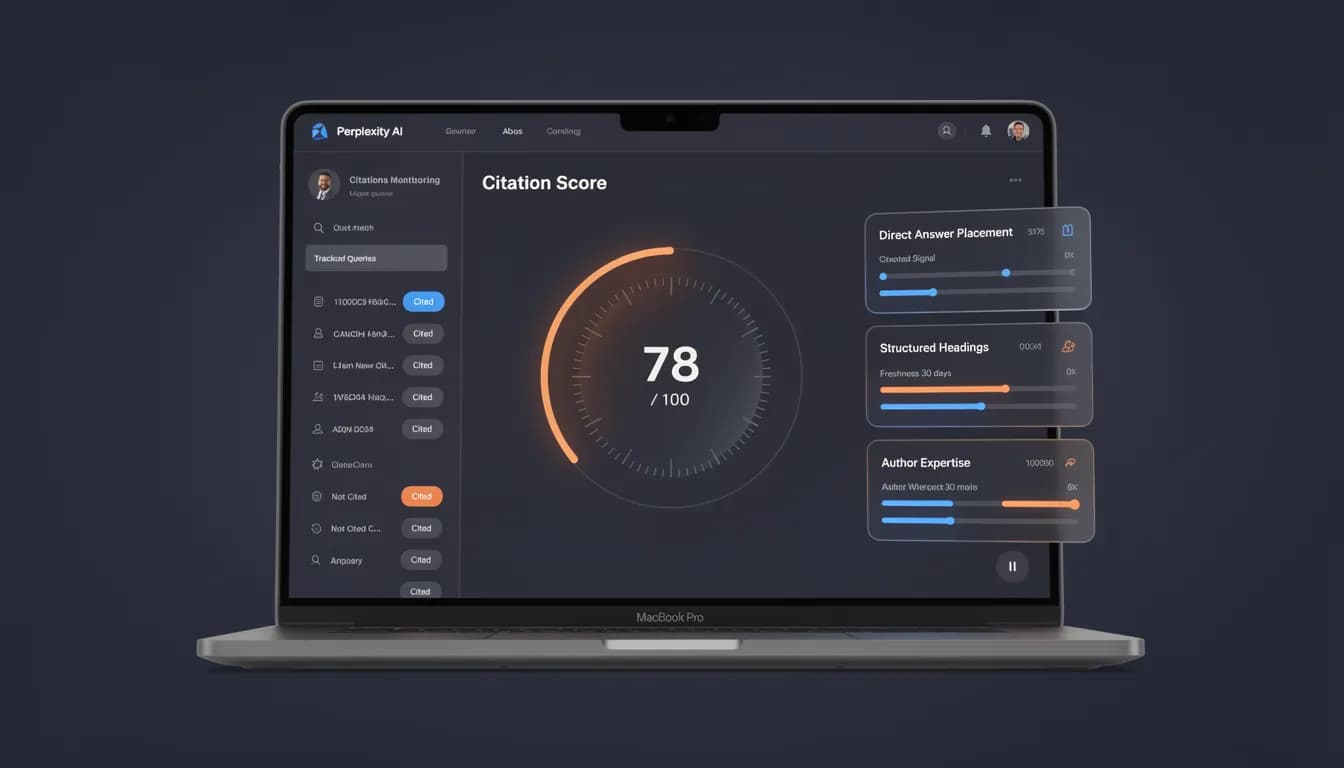
Your best article is on Google's first page. But when someone asks Perplexity the exact question it was written to answer, a smaller site gets cited instead — and your content is nowhere. That's not bad luck. The ranking signals Perplexity uses to select citations are different from what Google rewards, and most well-optimized content fails Perplexity's filters without anyone noticing. Are you actually optimizing for Perplexity, or just hoping Google authority carries over? Because those aren't the same strategy. And the gap between them is quietly opening.
What Perplexity Actually Uses to Rank Content
Most people assume Perplexity is just a better search interface — a prettier wrapper around Google or Bing results. That misunderstanding is exactly why so many well-optimized sites get passed over for citations.
Perplexity runs its own crawler, PerplexityBot, alongside pulling from the Bing index. But the selection logic for which pages get cited is not the same as what determines a Bing ranking. Perplexity is answering a specific question in real time, and its model selects sources based on how well a page directly answers that question — not just how authoritative the domain is.
This means three things:
- Topical precision beats topical breadth. A page that thoroughly covers one specific question often outperforms a comprehensive guide that covers ten.
- Structure is a citation signal, not a formatting preference. Perplexity's model reads structured content more reliably than dense prose. Headers, bullet points, and numbered lists make the answer extractable.
- Freshness matters more than it does in Google. Perplexity answers often involve recent developments. Content that has not been updated in 18+ months loses citation ground to newer pages even when the older page has stronger backlinks.
The core difference from Google: Perplexity does not primarily rank pages. It selects answer fragments. The page that gets cited is the one that makes the right answer easiest to extract.

The Surfer SEO Study: What 650,000 Perplexity Answers Revealed
The clearest picture of what Perplexity actually cites comes from a Surfer SEO study analyzing 650,000 Perplexity answers. The findings do not just confirm intuitions — several of them run directly counter to classic SEO assumptions.
What correlated most strongly with Perplexity citations:
- Direct answer placement. Pages that placed a clear, concise answer in the first two paragraphs were significantly more likely to be cited than pages that built to an answer over multiple sections.
- Sentence-level specificity. Vague language performed worse than specific language with concrete numbers and ranges. Perplexity's model rewards precision.
- Low reading complexity. Pages using shorter sentences and plain language were cited more frequently than content with high Flesch-Kincaid complexity scores — even when the topic was technical.
- Defined structure. Pages with clear H2/H3 hierarchy, bullet lists, and labeled sections outperformed equivalent content in paragraph-only format.
- Author expertise markers over domain authority. Named authors with credentials, linked bios, and explicit experience claims mattered more than raw domain metrics for non-branded queries.
What did not correlate as expected: word count above roughly 1,500 words, high backlink counts, or social sharing metrics. Perplexity's citation selection is answer-quality-focused, not link-authority-focused.
This distinction matters enormously for your content strategy. If you have been building content for Google's authority signals, you have work to do.
How Perplexity Crawls — and Why It Is Different From Google
Before you can optimize for Perplexity, you need to understand what PerplexityBot can and cannot access.
PerplexityBot follows standard robots.txt rules, so if you have blocked crawlers in the past, check whether your robots.txt is inadvertently blocking PerplexityBot. Many sites that blocked certain bots for Google Search Console purity are now discovering they have also blocked Perplexity.
Beyond crawl access, Perplexity's indexing behavior differs from Google's in a few practical ways:
Content rendering. Perplexity does not render JavaScript-heavy pages as reliably as Googlebot. If your content is loaded via client-side JavaScript, there is a real risk that PerplexityBot sees a near-empty page. This is particularly common on sites using modern JS frameworks without server-side rendering.
Citation recency. Perplexity refreshes its source pool more aggressively for recent queries. For news-adjacent topics like AI tools, regulation, and market changes, pages updated in the last 30 to 90 days have a measurable advantage over older content.
No page authority as a primary lever. Unlike Google's PageRank-influenced ranking, Perplexity does not weight citation decisions as heavily on external link profiles. This is good news for newer or smaller sites — if your content is structured well and answers the question directly, you can compete with sites that have 10x your domain authority.
This also connects to something broader happening in AI-driven search. The optimization logic for ranking in AI overviews and in platforms like Perplexity shares a common thread: how to rank in AI overviews involves similar answer-extraction signals, and understanding the full picture of LLM visibility helps you build a coherent multi-platform strategy.
7 Tactics to Get Cited by Perplexity
These are the tactics that move the needle based on what the citation data shows. Not theoretical — each is derived from the structural patterns of pages that consistently appear in Perplexity answers.
1. Lead With the Answer, Not the Setup
Your first paragraph should contain the direct answer to the query your page targets. Not a teaser, not context-setting — the actual answer. Then provide the depth, evidence, and nuance that follows. Perplexity's model pulls citation fragments from early in the page more often than from buried conclusions.
2. Use an Answer Box Format for Key Claims
Structure your most citable content using a clear label plus direct statement pattern. Lead with a bold label like The short answer: followed by a concise one to two sentence response. This format signals to the model that the following text is a direct answer, not setup.
3. Build Topical Authority at the Page Level
One question, answered deeply. Do not try to make every post a comprehensive hub that covers three related topics superficially. A 1,800-word post that exhaustively covers one specific question outperforms a 4,000-word post that covers five related questions at medium depth — at least for Perplexity citation purposes.
4. Make Your Structure Machine-Readable
Use consistent H2/H3 hierarchy. Use numbered lists for sequential steps. Switch to bullet points for feature comparisons. Reserve tables for specifications. Perplexity's extraction logic is essentially asking: what is the clearest labeled chunk of content I can pull here? Your job is to give it those chunks explicitly.
5. Add Author Expertise Signals
Named author, credentials visible on the page, links to a bio. For non-branded informational queries, Perplexity weighs expertise signals more heavily than pure domain authority. If your content is published under a generic byline or no byline at all, you are leaving citation opportunities on the table.
6. Update Your Best Pages Regularly
Add a visible last-updated date marker. Refresh data points with current figures. Even minor updates that touch recent data — tool pricing, study results, platform changes — register as freshness signals. This matters especially in fast-moving categories: AI tools, marketing technology, and regulatory topics all benefit significantly from fresh signals.
7. Check Your robots.txt and Rendering
Confirm PerplexityBot is not blocked. Confirm your key content pages render properly without JavaScript. If your content lives behind client-side JS, prioritize adding server-side rendering to your highest-value pages.

Perplexity Optimization Checklist
Use this before publishing any content you want Perplexity to cite:
- Direct answer in paragraphs 1 to 2 — does the page answer the target query within the first 200 words?
- H2/H3 hierarchy is clear and descriptive — do your headings tell the story without reading the text below them?
- At least one answer box or labeled summary — is your key claim formatted as a labeled direct statement?
- Specific numbers and sources — does every key claim include a concrete figure, study reference, or named source?
- Author expertise visible — is there a named author with credentials or experience markers on the page?
- robots.txt allows PerplexityBot — confirmed PerplexityBot is not blocked by your crawl rules?
- Content renders without JavaScript — does the page content load in a JS-disabled view?
A page that clears all seven boxes is not guaranteed a Perplexity citation — but a page that fails three or more of them almost certainly will not get one.
How to Track Your Perplexity Visibility
Here is the problem most teams run into: you cannot see Perplexity traffic in Google Analytics the same way you see Google organic traffic. Perplexity sends referral traffic, but it does not show up in your organic search channel, and standard SEO tools do not track whether your pages are being cited in Perplexity answers.
This is the gap that AI brand visibility monitoring addresses — and it is one most teams still have not solved.
What you actually need to know:
- For which queries is Perplexity citing your content vs. citing a competitor?
- Is your citation rate improving or declining after content updates?
- Which specific pages are being pulled into Perplexity answers?
Allable's GEO module tracks exactly this. For any keyword or topic cluster you are targeting, you can see your current Perplexity visibility score, compare it against competitors, and identify which pages are and are not getting cited. It connects the optimization work above to measurable outcomes — so you are not guessing whether your structural changes are moving the needle.
Frequently Asked Questions
- Does domain authority matter for Perplexity rankings?
- Domain authority matters less for Perplexity citations than it does for Google rankings. The Surfer SEO study of 650,000 answers found that content structure, direct answer placement, and author expertise signals were stronger predictors of citation than raw domain authority metrics. Newer or smaller sites can outrank established players if their content is better structured and more directly answers the query.
- How is Perplexity different from Google AI Overviews for optimization purposes?
- Both favor direct answers and structured content, but there are key differences. Google AI Overviews draw heavily from pages that already rank well organically — your Google ranking helps your AI Overview appearance. Perplexity is more independent: it evaluates pages through its own crawler and model selection, meaning Google ranking strength does not automatically translate to Perplexity citations. You often need to optimize for them separately.
- How often should I update content to maintain Perplexity citations?
- There is no fixed cadence, but fast-moving topics (AI, marketing tech, pricing, regulatory) benefit from updates every 60 to 90 days. The update does not need to be a full rewrite — refreshing data points, adding a recent study reference, or updating a last-updated date is often sufficient to reset freshness signals.
- Can I be blocked from Perplexity citation intentionally?
- Yes — if you want to prevent Perplexity from crawling your content, you can block PerplexityBot in your robots.txt using User-agent: PerplexityBot and Disallow: /. For most publishers, this is not advisable since Perplexity traffic is incremental, but it is an option if you have contractual reasons to restrict AI crawler access.
Find Out Where You Actually Stand in Perplexity
Perplexity is not rewarding the same sites Google rewards. If your Perplexity visibility is lower than your Google performance, that gap is structural — and it is fixable with changes most Google-optimized content teams have not made yet. Allable's GEO module gives you a Perplexity visibility score for any keyword cluster, shows which pages are being cited, and compares you against competitors.