
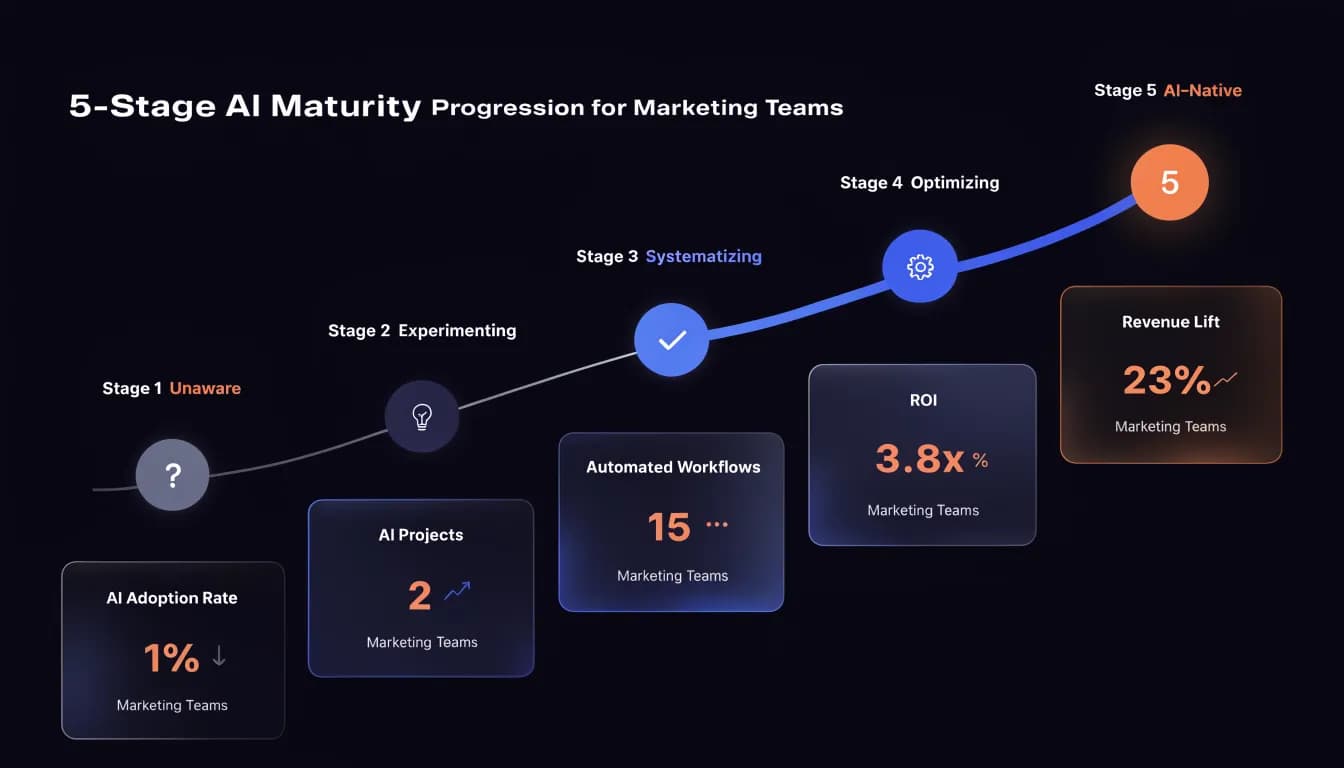
You're a marketing manager who takes AI seriously. Not a skeptic, not a hype-chaser — somewhere in the uncomfortable middle where you've shipped a few AI workflows, watched half of them quietly get abandoned, and told yourself the next one will be different. The uncomfortable truth most teams won't say in a meeting: your AI usage looks more sophisticated from the outside than it actually is. A handful of people using ChatGPT for captions and a shared Notion doc of prompts is not a strategy. It might not even be Level 2. But knowing exactly where you are is the one thing that actually changes where you end up. So: what level is your team actually at?
Somewhere in your organization, someone ran an AI experiment that worked. Your team probably ran three more after that. According to Gartner, 67% of those experiments never made it past pilot stage. The reason isn't tool quality. It's the gap between experimenting and actually embedding AI into how your team operates. There's a specific point in that gap where most marketing teams stall — and it's not where they think it is.
What Is an AI Maturity Model (And Why Marketing Teams Need One)
An AI maturity model is a framework that maps where your team actually stands in its AI adoption — not where you hope you are, not where your roadmap says you'll be next quarter.
The concept comes from software engineering maturity models (think Capability Maturity Model Integration, or CMMI), adapted for AI implementation. In a marketing context, it answers a practical question: are you using AI to do existing tasks faster, or are you using AI to do things that weren't possible before?
That distinction matters more than most teams realize. According to McKinsey's 2024 State of AI report, companies with mature AI implementations see 3–5x higher ROI compared to teams still in the experimental phase. The gap isn't about budget or tool access. It's about where you are in the model — and whether you know how to move up.
Only 8% of companies describe themselves as AI-native in their marketing operations, according to Forrester. Yet Zapier's 2024 research shows 74% of enterprises say losing their AI vendors would now disrupt core operations — meaning AI has become embedded even at early adoption stages. That gap — 74% organizationally dependent on AI, 8% operating with genuine AI-native maturity — is exactly where the AI maturity model becomes useful.
Your team needs an AI readiness assessment not to judge where you've been, but to make your next move deliberate. Without it, you're optimizing at random.
The 5 Levels of AI Maturity for Marketing Teams
The framework below reflects a synthesis of established models from Gartner, McKinsey, and real-world marketing team implementations. Each level describes behaviors, not intentions.

Level 1: Unaware — "We Don't Really Use AI Yet"
At Level 1, AI is either absent or purely individual. One person on your team uses ChatGPT for drafts occasionally. There's no shared process, no defined use case, and no expectation of AI as part of the workflow.
This is more common than the industry conversation suggests. Smaller agencies, traditional B2B marketing departments, and highly regulated industries often sit here — not because of ignorance, but because existing workflows haven't broken badly enough to force change.
What Level 1 looks like in practice:
- No AI tools in your shared tech stack
- Individual experimentation happens but isn't shared or systematized
- "AI strategy" means someone bookmarked an article about it
- Leadership awareness is low or skeptical
If your team is at Level 1, the first move isn't picking tools. It's identifying one specific, painful, repeatable task that AI could eliminate — and building proof around it.
Level 2: Experimenting — "We're Playing Around With It"
Level 2 teams are actively using AI, but without structure. You've run pilots. Some worked, some didn't. Enthusiasm is high but consistency is low. Zapier's 2024 research found that 74% of enterprises say losing their AI vendors would disrupt core operations — which tells you how embedded AI has become. But embedded at the individual level and embedded at the team workflow level are two very different things. Most of that 74% lives here.
This is the stage most teams get stuck in the longest. The hallmark of Level 2 isn't low adoption — it's invisible adoption. Everyone's doing something different with AI, using different tools, producing different quality results, with no way to measure whether any of it is working.
What Level 2 looks like in practice:
- Multiple disconnected AI tools across the team (often personal subscriptions)
- No shared prompt library or documented workflows
- Results are inconsistent — great output one week, unusable the next
- ROI tracking is nonexistent or anecdotal
- "We use AI" in conversations, but no one can define how, exactly
The risk at Level 2 isn't doing too little. It's building false confidence — assuming that because AI is being used, AI is being used well.
Level 3: Adopting — "We Have Real AI Workflows"
Level 3 is where the shift from individual use to team process happens. You've moved from experimenting to systematizing. Specific workflows are documented, AI tools are provisioned at the team level, and outputs are consistent enough to rely on.
This is the level where you start to see actual productivity impact. HubSpot's 2024 State of Marketing report found that marketing teams spend an average of 2.3 hours daily on tasks AI could handle. Level 3 teams have identified most of those tasks and have defined processes for handling them.
What Level 3 looks like in practice:
- Shared prompt libraries or workflow templates across the team
- AI tools integrated into your existing content, SEO, or campaign workflows
- Defined quality standards for AI-assisted output
- Basic tracking of time saved or output volume
- At least one person owns AI implementation across the team
The AI marketing tools your team adopts at Level 3 should connect directly to your existing processes — not sit alongside them as separate experiments.
Level 4: Scaling — "AI Is Part of How We Operate"
At Level 4, AI is no longer a separate initiative. It's built into your team's default way of working. New campaigns are planned with AI research built in. Content calendars are AI-assisted. Performance analysis runs on automated reports. Your team doesn't think "should we use AI for this?" — it thinks "how?"
The McKinsey 3–5x ROI advantage becomes visible at this level. You're not just saving time — you're doing things that weren't operationally possible before.
What Level 4 looks like in practice:
- AI embedded across the full marketing workflow (research → create → distribute → analyze)
- Clear ownership of AI outputs and quality checks
- Regular audits of AI tool effectiveness and ROI
- Teams outside marketing start asking how you're doing it
- AI capabilities factor into hiring and role definition
At Level 4, AI-native marketing workflows start to define your competitive edge — the gap becomes visible to clients, not just internally.
Level 5: Leading — "We Build With AI, Not Just Use It"
Level 5 is rare. Forrester puts it at 8% of companies. At this level, your marketing team doesn't just use AI tools — it shapes how AI is deployed across the organization, builds proprietary workflows and automations, and actively experiments with emerging capabilities before they become mainstream.
AI-native marketing organizations at Level 5 treat their AI implementation as a competitive moat, not just a productivity improvement. They have internal documentation of what works, feedback loops that improve outputs over time, and leadership that includes AI capability development in strategic planning.
What Level 5 looks like in practice:
- Custom automations built on top of AI APIs (not just UI tools)
- Internal AI benchmarking — testing new models and approaches systematically
- Cross-functional AI governance: marketing, product, legal, ops aligned
- Proprietary prompt engineering, fine-tuned outputs, or custom integrations
- Your team publishes case studies others reference
Most teams reading this article won't be at Level 5. That's fine. Level 3 to Level 4 is where the practical ROI lives for most marketing organizations.
AI Readiness Assessment: Which Level Are You At?
This self-assessment is designed to give you a fast, honest read on your team's actual position. Answer based on what's consistently true — not on your best day or your aspirational roadmap.
Question 1 — Tool Access Which best describes your team's AI tool situation?
- A) No AI tools in our current stack (Level 1)
- B) Some individuals use personal accounts; no team-level access (Level 2)
- C) We have team-level AI tool subscriptions with defined use cases (Level 3)
- D) AI tools are provisioned for the whole team and integrated into core workflows (Level 4)
- E) We build on top of AI APIs and have proprietary automations (Level 5)
Question 2 — Process Documentation Do you have documented AI workflows your team actually uses?
- A) No documentation exists (Level 1–2)
- B) Some notes or prompts shared informally (Level 2)
- C) Documented workflows for at least 3 core marketing tasks (Level 3)
- D) AI workflow documentation is maintained and regularly updated (Level 4)
- E) We have an internal AI playbook and governance documentation (Level 5)
Question 3 — Output Consistency How consistent is the quality of your AI-assisted output?
- A) We don't produce AI-assisted output systematically (Level 1)
- B) Varies widely — great sometimes, unusable others (Level 2)
- C) Consistent enough to rely on, with human review at defined checkpoints (Level 3)
- D) Highly consistent; AI output meets quality bar without heavy editing (Level 4)
- E) AI output is often indistinguishable from our top-performing human work (Level 5)
Question 4 — ROI Tracking Can you quantify the business impact of your AI use?
- A) No — we don't track it (Level 1–2)
- B) Anecdotally — "it seems to save time" (Level 2–3)
- C) Yes — we measure time saved and output volume (Level 3)
- D) Yes — we track time, output quality, and revenue attribution where possible (Level 4)
- E) We have an internal AI ROI model tied to business KPIs (Level 5)
Question 5 — Leadership Commitment How does your leadership treat AI capability development?
- A) It's not a priority or there's active skepticism (Level 1)
- B) Leadership is interested but hasn't committed resources (Level 2)
- C) Budget and time allocated for AI tools and training (Level 3)
- D) AI capability is included in team hiring criteria and role definitions (Level 4)
- E) AI strategy is part of formal business planning and competitive positioning (Level 5)
Scoring: Count your most common letter. That's your current level. If you're split between two adjacent levels, you're in transition — which is the most actionable place to be.
What Moves You to the Next Level
Knowing your level is step one. The moves between levels follow predictable patterns.

Level 1 → Level 2: Your first proof of concept
Pick one specific, high-frequency, painful task. Brief writing. Competitive summaries. First drafts of ad copy. Run AI on that one task for 30 days. Document the result. Show it to one other person on your team. That's it. You don't need a strategy. You need one working example.
Level 2 → Level 3: Systematize what's already working
You already have at least one AI workflow that works. The problem is that only one or two people use it. Level 3 is about making that workflow team-wide. Write it down. Create a shared prompt template. Define a quality check. Measure outputs. This transition is organizational, not technical.
Level 3 → Level 4: Connect the dots across the workflow
At Level 3, your AI use is probably siloed by function — content here, SEO there, ads somewhere else. Level 4 means connecting those workflows so they reinforce each other. Your AI-assisted content research feeds your SEO keyword strategy. Your campaign insights feed your next content brief. Integration is the move.
A platform like Allable (Free forever | Pro: $34/month | Business: $99/month) is built for this transition — AI that works across your full marketing workflow rather than as isolated point solutions.
Level 4 → Level 5: Build proprietary advantages
This transition requires deliberate investment. You start building on top of AI capabilities, not just using packaged tools. Custom automations. Prompt engineering at scale. Internal benchmarking. Most marketing teams don't need to reach Level 5 to generate significant ROI — but the ones who do create competitive advantages that are genuinely hard to replicate.
The Hidden Bottleneck: It's Not the Tools
Most conversations about AI maturity focus on tool selection. Which AI platform to use. Which features to prioritize. Whether to build or buy.
That's the wrong conversation for most teams.
The actual bottleneck between Level 2 and Level 3 — where most teams stall — is organizational, not technical. It's the absence of someone who owns AI implementation. Not a vendor. Not an IT department. A person on your marketing team who is responsible for turning individual experiments into repeatable workflows.
67% of AI experiments never scale beyond pilot stage (Gartner). The common thread isn't tool failure. It's ownership failure. No one decided that the experiment that worked needed to become a process.
The second hidden bottleneck is quality standards. AI output without a defined quality bar produces inconsistency. Inconsistency breeds distrust. Distrust sends your team back to manual processes. You can't scale what you don't trust.
If your team is stuck between levels, the diagnostic question isn't "what tool are we missing?" It's: "Who owns this, and what does good output look like?"
AI maturity at Level 4+ increasingly means moving from AI-assisted tasks to AI-orchestrated workflows — a shift that changes both what your team can deliver and how it's staffed.
Frequently Asked Questions
- What are the 5 levels of AI maturity?
- The five levels of AI maturity for marketing teams are: Unaware (no systematic AI use), Experimenting (ad-hoc individual use without structure), Adopting (team-level workflows and documented processes), Scaling (AI embedded across the full marketing operation), and Leading (AI-native culture with proprietary capabilities). Most marketing teams currently sit between Level 2 and Level 3.
- How long does it take to move between AI maturity levels?
- The transition from Level 1 to Level 2 can happen in 2–4 weeks with one focused proof of concept. Level 2 to Level 3 typically takes 2–3 months of deliberate systematization. Level 3 to Level 4 often takes 6–12 months and requires organizational commitment, not just tool access. Level 4 to Level 5 is a multi-year investment with dedicated resources.
- What is a marketing AI adoption assessment?
- A marketing AI adoption assessment is a structured evaluation of your team's current AI capabilities across four dimensions: tool access, process documentation, output consistency, and leadership commitment. Unlike a simple technology audit, it measures organizational readiness, not just software inventory. The self-assessment quiz in this article gives you a starting-point read in under 10 minutes.
- What does an AI implementation roadmap look like for a marketing team?
- An AI implementation roadmap for marketing starts with level identification (where you are today), then defines the one or two capabilities needed to reach the next level. Effective roadmaps are 90-day cycles, not annual plans — the technology changes too fast for longer horizons. Each cycle includes a defined owner, a measurable output target, and a quality standard for AI-assisted work.
- Is an AI maturity model only for large enterprises?
- No. The 5-level AI maturity framework applies equally to a 3-person startup marketing team and a 300-person enterprise department — the behaviors are the same at each level, just at different scale. In practice, smaller teams can often advance faster because there are fewer organizational layers between the decision to systematize and the actual implementation.
- How do I know if my team is AI-ready?
- AI readiness isn't a binary state — it's a spectrum. The more useful question is whether your team has: one clear AI use case with a defined quality standard, one person accountable for AI implementation, and leadership support to allocate 2–4 hours per week to developing and documenting workflows. If those three conditions exist, your team is ready to move to the next level regardless of current position.
See Where Allable Fits in Your AI Maturity Journey
Allable is built for marketing teams at Level 3 and above — connecting AI-assisted research, content, SEO, and campaign management in a single workflow. Free forever plan available; Pro from $34/month.