
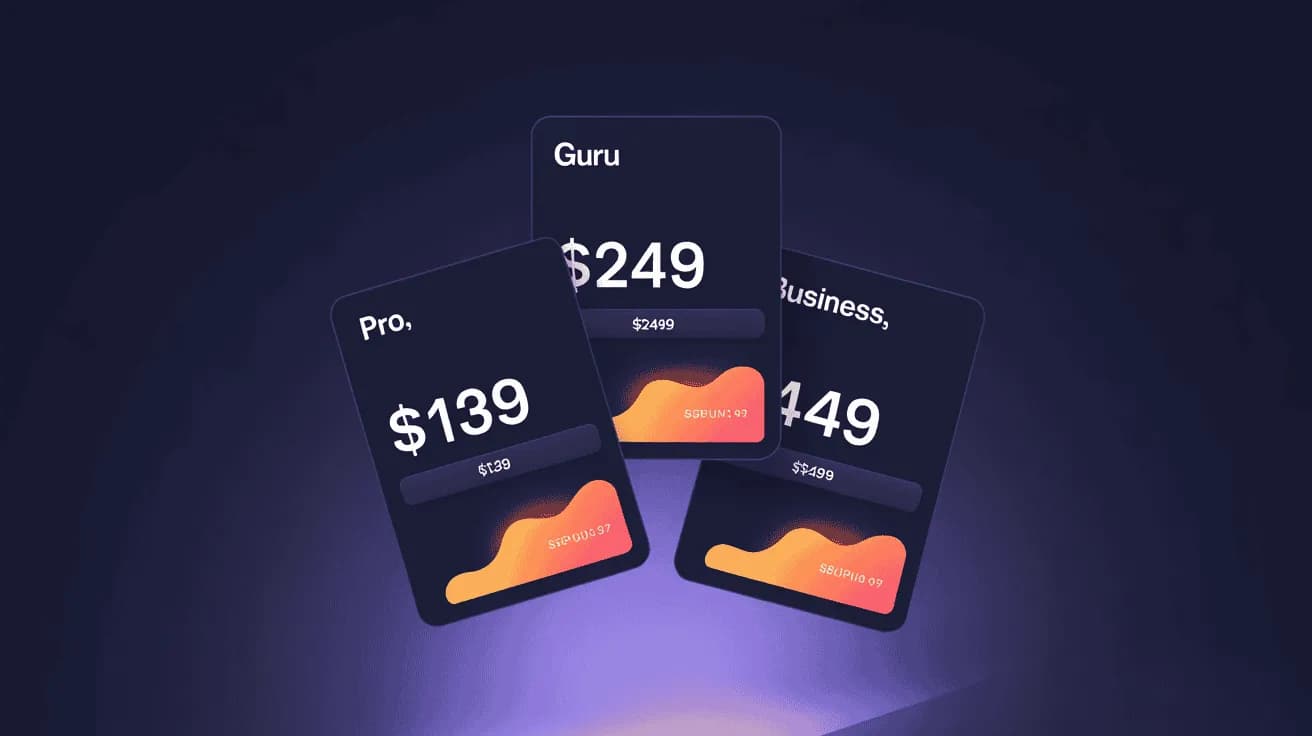
Semrush knows exactly what it costs to run a marketing team — and it's priced accordingly. At $139.95/month for the entry plan, you get powerful SEO data. You do not get content creation, AI writing, image generation, or social scheduling. Those cost extra, from separate tools, billed separately. How many tools are you actually paying for this month to do what you used to think one subscription would handle? That's the real Semrush pricing question — not just the base plan rate.
Semrush Pricing at a Glance
Here's how the two pricing tracks compare side by side.
Plan | Monthly Price | Annual Price (per month) | Best For |
|---|---|---|---|
Semrush One SEO | ~$139 | ~$117 | SEO specialists only |
Semrush One Starter | $199 | ~$167 | Small teams, basic all-in-one |
Semrush One Pro+ | $299 | ~$251 | Growing teams needing more limits |
Semrush One Advanced | $549 | ~$461 | Agencies, heavy users |
Classic Pro | $139.95 | $117.33 | Core SEO, solo use |
Classic Guru | $249.95 | $208.33 | Agencies, historical data |
Classic Business | $499.95 | $416.62 | Enterprise SEO teams |
All prices are per user per month unless noted. Add-ons are extra and priced separately — that comes later.
Semrush One Plans (The New Default)
Semrush One is the company's current default offering. It's positioned as an all-in-one platform rather than a pure SEO tool. If you sign up today, this is what you'll see first.
Semrush One SEO (~$117–$139/mo)
This is the entry point for users who exclusively need SEO functionality. You get access to keyword research, organic traffic analysis, site audit, backlink analysis, and rank tracking. At $117/month on an annual plan, it's cheaper than the Classic Pro on a monthly basis — but only marginally. The limit is that it's SEO-only. No content marketing tools, no social, no ads features. If that's all you need, it's a clean, defensible purchase.
Semrush One Starter ($199/mo, ~$167 annual)
Starter unlocks more of the platform — SEO plus some content and competitive intelligence tools. It's aimed at small marketing teams or solo operators who want one interface for multiple tasks. At $199/month, it's a meaningful step up. You get higher keyword query limits, access to Semrush's content marketing toolkit (topic research, SEO content template), and basic social tools. For a two-person marketing team trying to avoid multiple subscriptions, this is the plan worth evaluating first.
Semrush One Pro+ ($299/mo, ~$251 annual)
Pro+ sits in the middle of the Semrush One lineup. The main difference from Starter is expanded usage limits — more projects, more tracked keywords, higher API access, and the ability to add team members at a lower per-seat cost. The platform features are similar to Starter, but the limits matter if you're managing multiple client sites or running keyword research at scale. If you're an agency with five or more active clients, Pro+ becomes relevant.
Semrush One Advanced ($549/mo, ~$461 annual)
This is the top tier of Semrush One. You get the highest limits, full access to all platform features including Share of Voice metrics, advanced reporting, and priority support. At $549/month, it's positioned squarely at agencies and in-house enterprise teams. The per-seat cost also becomes more manageable here relative to lower tiers. If you need more than what Pro+ gives you, this is the ceiling before custom enterprise pricing.
Classic SEO Plans (Still Available)
Semrush still offers its original three-tier structure. These plans are SEO-focused and don't include the broader marketing tools bundled in Semrush One. They remain available for existing customers and for new users who prefer the classic structure.
Pro — $139.95/month ($117.33 billed annually)
The original entry-level plan. You get 5 projects, 500 tracked keywords, 10,000 results per report, and access to the core SEO toolkit. This is the plan most individual SEO specialists and freelancers start with. The limits are tight if you're managing more than two or three client sites simultaneously. Position tracking updates daily, site audit crawls up to 100,000 pages per month, and backlink analysis covers the full index. At $117.33/month annual, it's price-competitive with the Semrush One SEO tier.
Guru — $249.95/month ($208.33 billed annually)
Guru removes most of the limits that make Pro frustrating at scale. You get 15 projects, 1,500 tracked keywords, and access to historical data — which is the real differentiator. Historical data lets you see how a keyword's difficulty and volume changed over time, which matters for trend analysis and reporting to clients. Guru also includes the Content Marketing Platform (topic research, SEO writing assistant, content audit), making it a popular choice for agencies that need both SEO depth and content workflows. At $208.33/month annual, it's the most common choice for mid-size agencies.
Business — $499.95/month (~$416.62 billed annually)
Business is the Classic plan for large agencies and enterprise teams. You get 40 projects, 5,000 tracked keywords, API access, and extended limits across the board. The price reflects the volume, not additional features over Guru. If you're running SEO at scale — 20+ client sites, dedicated reporting workflows, team access — Business makes the per-client cost math work better. Below that threshold, you're paying for limits you won't hit.
What You Don't Get (Add-On Costs)
Here's where the actual monthly spend diverges from the advertised plan price.
ContentShake AI — ~$60/month
ContentShake is Semrush's AI content writing tool. It's not included in most Semrush One or Classic plans at the base tier. If you want AI-assisted drafts, brief generation, and real-time SEO suggestions while writing — which is a core use case for many marketing teams — you pay $60/month on top of your plan. Add that to a Starter plan and you're already at $259/month before anything else.
Social Toolkit
Semrush's social media management tools — scheduling, analytics, monitoring — are available on higher tiers or as add-ons on lower ones. The level of access depends on your plan. If you're on Classic Pro, social features are limited. If you need full social scheduling and analytics, expect an additional cost or an upgrade.
Extra Users — $45+/month per seat
Every Semrush plan includes one user. Additional users on Classic plans cost $45/month per seat. On Semrush One plans, multi-seat pricing is bundled differently depending on tier, but the per-user cost remains meaningful. A two-person SEO team on Classic Guru is paying $249.95 + $45 = $294.95/month. A three-person team hits $339.95/month — before any add-ons.
Real Total Cost Example
A mid-size agency running Semrush Guru with two team members and ContentShake:
- Guru annual: $208.33/month
- Extra seat: $45/month
- ContentShake AI: $60/month
- Total: $313.33/month ($3,759.96/year)
That's the real number. Not $249.95.
Annual vs Monthly — How Much You Save
Semrush offers approximately 16–17% savings on annual billing compared to paying month to month.
Plan | Monthly Cost | Annual (per month) | Annual Savings |
|---|---|---|---|
Classic Pro | $139.95 | $117.33 | $270.24/year |
Classic Guru | $249.95 | $208.33 | $499.44/year |
Classic Business | $499.95 | $416.62 | $999.96/year |
Semrush One Starter | $199 | ~$167 | ~$384/year |
Semrush One Pro+ | $299 | ~$251 | ~$576/year |
Semrush One Advanced | $549 | ~$461 | ~$1,056/year |
The math is consistent: annual billing saves roughly $270 to $1,000+ depending on plan. If you're confident you'll use Semrush for 12 months, annual is straightforwardly better. The risk is locking in before you've validated the plan actually fits your workflow. Start monthly, switch to annual once you've confirmed the limits don't choke your usage.
Semrush Free Trial — What You Actually Get
Semrush offers a 7-day free trial on paid plans. You need a credit card to start. After 7 days, you're billed at the full plan rate.
There's also a permanent free account tier. With a free Semrush account, you can run up to 10 searches per day across keyword research and domain analytics. Reports are limited — you typically see 10 results instead of thousands. You can't track keywords, run full site audits, or access historical data.
The free tier is useful for one thing: getting a feel for the interface and confirming the data exists for your targets. It's not a substitute for a paid plan if you're doing real SEO work. The 10-search limit will frustrate you by the end of day one.
The 7-day trial gives full access to your selected plan's features. It's enough time to run a keyword gap analysis, audit a site, and pull competitor backlink data. Use those 7 days intentionally — run the specific workflows you'd rely on weekly, not just explore the interface.
Semrush vs. Alternatives — Honest ROI Comparison
| Semrush Guru | Allable | SE Ranking |
|---|---|---|---|
Monthly price (annual) | $208.33 | From $49 | From $65 |
SEO keyword research | ✅ Full | ✅ Full | ✅ Full |
Site audit | ✅ | ✅ | ✅ |
Backlink analysis | ✅ Deep | ✅ | ✅ |
Rank tracking | ✅ | ✅ | ✅ |
Content creation (AI) | Add-on $60/mo | ✅ Included | Limited |
Paid campaign tools | Add-on | ✅ Included | ❌ |
Social media management | Add-on/limited | ✅ Included | ❌ |
Competitive intelligence | ✅ Deep | ✅ | Basic |
Extra users | $45/seat/mo | Included | $20/seat/mo |
Learning curve | High | Low | Medium |
Best for | Agencies, SEO specialists | All-in-one marketing teams | Budget-focused SEO |
If you need only SEO data — keyword research, rank tracking, backlink analysis, technical audits — Semrush One SEO at $117–$139/month is defensible. The data quality is industry-leading. No serious argument there.
If you need SEO plus content creation, campaign management, social scheduling, and team collaboration, Semrush starts requiring additions. ContentShake adds $60. Social tools add more. Extra seats add $45 per person. You're building a stack around one tool, and the combined cost climbs past $300, $400, or $500/month quickly. That's when the math breaks — because at that spend level, all-in-one platforms become directly competitive on price while covering the full surface area.
Who Should Pay for Semrush (and Who Shouldn't)
You should pay for Semrush if:
You're an SEO agency managing 10 or more client sites. Semrush's data depth — particularly its keyword database size, historical trend data, and backlink index — is genuinely differentiated at agency scale. The reporting features and white-label options make client deliverables faster. At $208.33/month for Guru (annual), the per-client cost across 10 clients is $20.83/client. That's easy to justify.
You're a dedicated SEO specialist at a company where SEO is your primary and sole function. You need the deepest possible data, you'll use the full audit and tracking suite daily, and your company doesn't need you to also handle content, campaigns, and social from the same tool. In this profile, Semrush at $117/month (annual) is the right call.
You shouldn't pay for Semrush if:
You're a solo content marketer or freelance writer who needs some keyword data. Semrush's pricing is built around the assumption that SEO is your primary discipline and workflow. If you're checking keyword volume for two blog posts a week, the 10 free searches per day on a free account may be enough — or a lighter tool at $30–$50/month will cover your actual usage.
You're a marketing team that needs SEO, content creation, ad campaign management, social, and analytics in one place. Semrush is SEO-first. Everything else is bolted on at extra cost. A team trying to use Semrush as its marketing operating system will spend more and get a worse experience than a platform built around that use case from the start. The stack you'd assemble around Semrush — plus ContentShake, plus social, plus reporting — costs more than a true all-in-one and adds switching overhead between tools.
You're a small business owner doing your own marketing. The complexity and pricing aren't calibrated for that use case. You'll underuse what you're paying for.
FAQ — Semrush Pricing
1. How much does Semrush cost per month in 2026?
Semrush plans start at approximately $117/month (Semrush One SEO or Classic Pro, billed annually). Monthly billing starts at $139.95. Mid-tier plans (Guru, Semrush One Pro+) run $208–$299/month. The top public tier (Classic Business, Semrush One Advanced) reaches $499–$549/month. Add-ons, extra seats, and monthly billing all increase the real cost. Enterprise pricing is available above these tiers but requires a custom quote.
2. What's the difference between Semrush One and Classic plans?
Semrush One is the newer track, designed as a broader marketing platform. It includes more marketing channels at each tier — content tools, some social features, campaign intelligence — alongside SEO. Classic plans are SEO-first and offer the same core keyword, backlink, and audit data but with tighter focus. Classic plans are still available. If you need only SEO, Classic Pro or Semrush One SEO are the relevant entry points. If you want broader marketing tools without add-ons, Semrush One Starter or higher is the better starting point.
3. Does Semrush have a free plan?
Yes. A permanent free account lets you run 10 keyword or domain searches per day with limited result depth. You don't get keyword tracking, full site audits, or historical data. The free plan is useful for testing whether Semrush's data covers your market and targets. It's not viable for ongoing SEO work. Semrush also offers a 7-day trial of paid plans — credit card required.
4. Is Semrush worth the price for small businesses?
For most small businesses, no. The pricing is built around the assumption that someone on your team uses SEO tools intensively, daily. If you're publishing 2–4 blog posts per month and checking basic rankings, the cost-to-use ratio is poor. Lighter alternatives exist at $30–$65/month that cover small-business SEO needs without the complexity. If you're a small business where SEO is a serious, primary acquisition channel and you're willing to invest in learning the tool, Guru at $208/month annual has a case. But that's a specific profile.
5. What's cheaper than Semrush with similar features?
SE Ranking starts at $65/month (annual) and covers keyword research, rank tracking, site audit, and backlink analysis at solid depth. It's the closest direct substitute on a budget. Ahrefs starts at $129/month and is directly competitive with Semrush on SEO depth — the preference between them often comes down to which data you trust more. Allable starts at $49/month and covers SEO alongside content creation, campaign management, and social tools — a different value proposition if you need the broader surface area. None of these are identical to Semrush, but each serves specific use cases at lower price points.
Allable covers keyword research, site audits, rank tracking, content creation, campaign management, and social from a single platform. No add-ons required. [See how Allable compares →](https://allable.ai)