Best Personalized AI Assistant for Marketing Teams: Tools That Learn Your Brand
 Written by Martin J.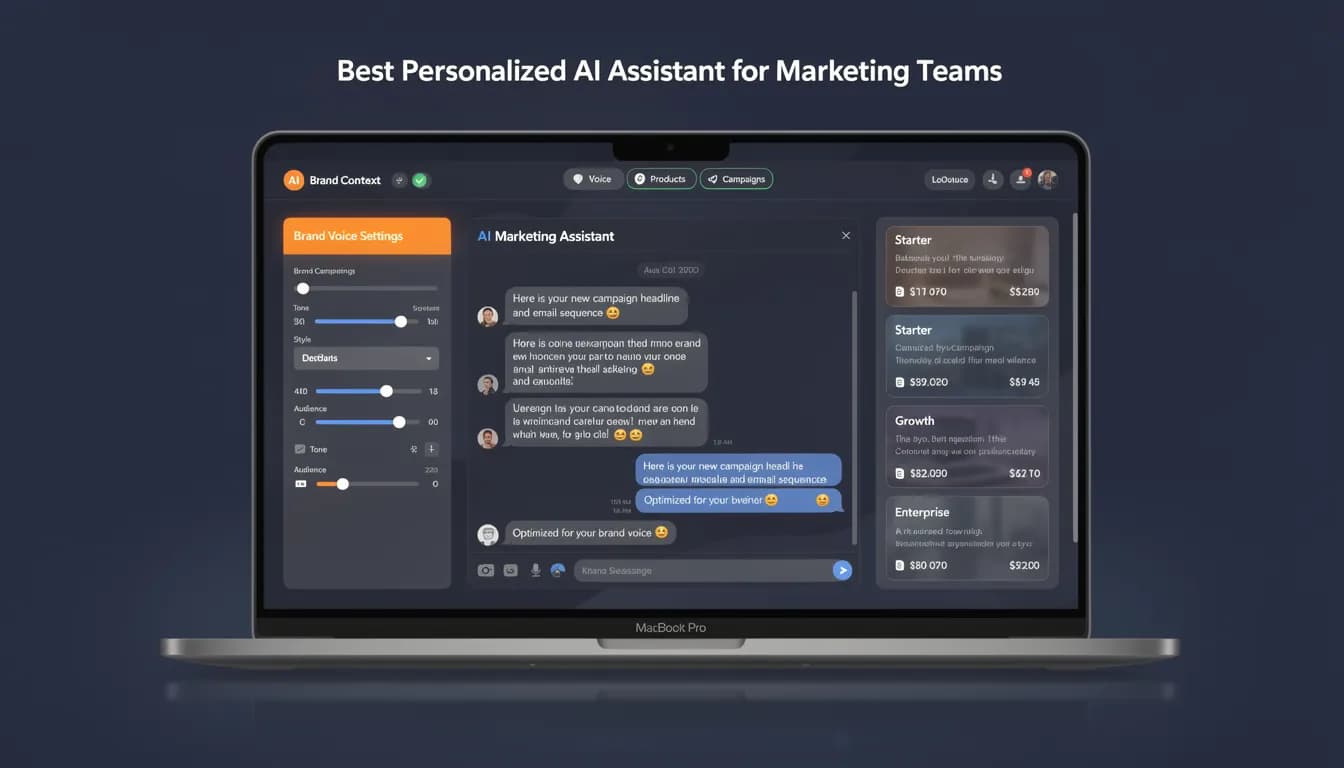
Nobody talks about the real cost of generic AI for marketing teams. Not the subscription price — the cost of re-explaining your brand in every single session. Your tone, your positioning, your product details. You've been writing the same context briefing over and over and calling it prompting skills. That isn't a prompting problem. That's a personalization problem. A personalized AI assistant for marketing solves a different challenge than ChatGPT: not 'can AI write this' but 'can AI write this exactly the way your team would.' Are you actually using AI for marketing — or using AI for tasks that happen to be marketing, with your brand stripped out?
87% of marketers now use generative AI in at least one workflow, up from 51% two years ago. But when you look at what teams are actually producing, a pattern emerges: most AI-assisted marketing content is technically correct and completely unmemorable. It sounds like every other brand that uses the same tool with the same prompts. The personalization layer — the thing that makes content sound like you — isn't coming from the AI. It's coming from whatever context you managed to fit into a single prompt window before hitting send.
There's a version of AI marketing assistance that actually works. It's not a better prompt. It's an AI that carries your brand context permanently, understands your competitive position, knows your products at the feature level, and builds on what you've already created. This guide covers what that looks like, which tools come closest to delivering it, and how to set one up for your team.
What Makes an AI Assistant "Personalized" for Marketing?
"Personalized" has been diluted into meaninglessness by marketing software marketing. In the context of AI assistants, it means something specific: the AI knows enough about your marketing operation that you don't have to explain it before every task.
That requires three layers working together — what I call the personalization stack.
Layer 1: Brand voice and tone
Not "professional but approachable." Your actual voice — specific sentence length, vocabulary preferences, what topics you avoid, whether you use first-person singular or plural, how direct your CTAs are. This needs to be codified as rules, not descriptions, and those rules need to live in the AI's working memory.
Brand consistency isn't a soft marketing value. Research across 200+ organizations found consistent brand presentation increases revenue by 23–33% across all channels. A personalized AI assistant is one of the most practical tools for enforcing that consistency at scale.
Layer 2: Product and competitive knowledge
An AI assistant that doesn't know your current pricing, your feature set, or how you're positioned against specific competitors will confidently write content that's wrong. Not fabricated-wrong — outdated-wrong or framing-wrong. It'll mention features you no longer offer, use pricing from six months ago, or describe a competitor in terms that contradict your current positioning.
This layer requires live data connections, not just a one-time document upload.
Layer 3: Campaign and audience history
What have you already said to which audience segments? What campaigns are running? What topics have you covered? What messaging has worked and what has flopped? An AI that doesn't have access to this history will repeat yourself, contradict your existing content, or recommend strategies you've already tested and retired.
Without all three layers, your AI assistant is a generic content generator. With them, it's an extension of your marketing team. The gap between the two is exactly where most AI marketing ROI disappears.

5 Personalization Capabilities That Actually Matter for Marketing Teams
Not every "personalization" feature in an AI marketing tool does the same work. Here's what to actually evaluate:
1. Brand voice enforcement — not suggestions
The difference between an AI that can "match your tone" and one that enforces your brand rules is the difference between editing every output and publishing most of them. Look for tools that let you define voice as explicit rules (not just style examples) and test those rules against outputs before deploying them in real workflows.
AI personalization engines that properly enforce brand guidelines deliver, on average, 2.7x ROI versus generic AI content tools. The mechanism is simple: less editing time, more consistent quality, faster publication velocity.
2. Live product knowledge
Your AI assistant needs to know what you're selling right now — not what your website said when it was last scraped. This means integration with your product data or CRM, or at minimum a structured data source you update regularly. Without this, you risk publishing AI-generated content that contradicts your current pricing or feature set.
3. Audience segment awareness
Different segments need different language. Your SMB customers need different framing than your enterprise prospects. A personalized AI assistant should know your segments, their specific jobs-to-be-done, and the language they use — not just "B2B SaaS buyers." The more specific the audience context, the less editing each output needs.
96% of consumers say they are more likely to purchase when brands personalize their outreach. That personalization starts with the AI understanding who it's writing for — not just what it's writing about.
4. Historical content context
Knowing what you've published prevents duplication, maintains internal link coherence, and lets the AI reference — rather than repeat — your existing positions. It also enables genuine content strategy work: identifying gaps, flagging cannibalization risks, and surfacing refresh opportunities based on what's already in your library.
5. Workflow integration — not just chat
The highest-value use of a personalized AI assistant isn't one-off requests. It's standing workflows: weekly performance summaries, post-publish social amplification, brief templates pre-filled with your requirements. These are only possible when the AI is integrated into your workflow — not living in a separate chat window you open for ad-hoc tasks.
For deeper coverage of where this workflow logic is heading, see our piece on agentic marketing tools — the natural evolution once the personalization layer is in place.
Best Personalized AI Assistants for Marketing in 2026
Here's how the main options compare on the five capabilities above.

Allable.ai — Built for the full marketing stack
Best for: Marketing teams who want a single AI across all marketing functions with persistent brand context.
Allable is built specifically for marketing teams — not a general-purpose AI configured for marketing use cases. The persistent memory layer means your brand voice, competitive positioning, and campaign history are available across every module: SEO research, content creation, campaign planning, competitive analysis, social. Context doesn't break when you switch tasks.
The practical outcome: a marketing manager spending 40 minutes on briefs instead of the previous 3 hours — not because the AI types faster, but because it already knows the context the brief requires.
Key capabilities: Persistent brand memory, multi-module context sharing, marketing-specific training, integrated SEO + content + campaign workflow.
Pricing: Free forever | Pro: €31/month | Business: €91/month
The full personalization layer — brand memory, competitive context, multi-module workflow — is available from the Pro plan.
Personalization score: 5/5 — native to every module, not bolted on.
Jasper — Strong brand voice, limited operational context
Best for: Teams who need brand-consistent content at scale and are already managing their own research layer.
Jasper's brand voice feature trains on up to 20 existing documents and reaches approximately 85% tone accuracy once configured. Its marketing template library is genuinely useful — ads, emails, social posts, landing pages — and the workflow has improved significantly in 2025.
The limitation: Jasper doesn't know your current products, pricing, or competitive position unless you tell it every session. Brand voice is Layer 1 of the personalization stack. Layers 2 and 3 require separate management.
Key capabilities: Brand voice templates, marketing content templates, team collaboration.
Pricing: $39/month (Creator) / $59/month (Pro)
Personalization score: 3/5 — strong on voice, limited on operational context.
Writer.com — Enterprise brand governance
Best for: Large teams where consistent terminology and compliance review are the priority — governance over productivity.
Writer.com excels at enforcing brand standards across large organizations. Clients including Accenture, Deloitte, and Viasat use it for brand consistency at scale. The background AI surfaces style recommendations without rewriting, which some teams prefer.
The limitation: Writer.com is a governance tool more than a marketing productivity assistant. It manages what you write — it doesn't help you write more, faster, with full context. There's no campaign planning, no competitive analysis, no SEO integration.
Key capabilities: Approved terminology database, style guide enforcement, team-wide consistency.
Pricing: $18/user/month (Team) — enterprise pricing on request.
Personalization score: 3/5 — strong governance, limited as an active assistant.
Custom GPT (ChatGPT) with brand guide
Best for: Teams who want a low-cost, flexible setup and are willing to manage the personalization layer manually.
Building a Custom GPT with your brand documentation uploaded is a legitimate approach for teams with limited budget. You upload your voice guide, key product docs, and positioning materials — and the Custom GPT references them in every conversation.
The limitations are real: the personalization layer degrades over time as your brand evolves unless you actively maintain the uploaded documents. There's no workflow integration, no live data connections, and no cross-session memory beyond what you've uploaded. It's personalization via document — static rather than dynamic.
Key capabilities: Brand doc reference, flexible prompting, API access.
Pricing: $20/month (ChatGPT Plus) — Custom GPT access included.
Personalization score: 2/5 — functional but maintenance-heavy.
HubSpot AI Copilot — CRM-native, marketing-partial
Best for: Teams whose personalization needs are primarily customer-data-driven and who live inside HubSpot.
HubSpot's AI Copilot has a genuine advantage: it knows your customer data, deal stages, contact properties, and email engagement history. For sales sequences and CRM-connected outreach, that context is genuinely valuable.
The limitation for pure marketing work: it doesn't learn your brand voice in a configurable way, it's constrained to HubSpot data sources, and it doesn't cover cross-channel campaign strategy or content marketing workflows outside the HubSpot ecosystem.
Key capabilities: CRM-connected context, email and sales sequence generation, HubSpot workflow integration.
Pricing: Included in HubSpot Marketing Hub ($800+/month for full features).
Personalization score: 3/5 — deep customer context, limited brand voice layer.
Verdict: which tool for which team size
Team size | Recommended | Why |
|---|---|---|
Solo marketer / freelancer | Allable.ai (Free / Pro) | Full toolset, lowest cost of context maintenance |
Small team (2-5 people) | Allable.ai Pro | Shared brand context, multi-module workflow |
Mid-market (5-20 people) | Allable.ai Business or Jasper Pro | Depends on whether workflow integration or content volume is the priority |
Enterprise | Writer.com + Allable.ai | Governance layer (Writer) + active AI assistant (Allable) |
Already in HubSpot | HubSpot AI Copilot + Allable.ai | CRM context (HubSpot) + marketing AI context (Allable) |
How to Set Up a Personalized AI Assistant for Your Marketing Team
The gap between teams that get real value from AI and teams still getting generic outputs is almost always this: the ones getting value invested upfront in their context layer. Here's the setup that works.
Step 1: Define what "personalized" means for your team
Before configuring anything — write down the three or four outputs where you'd most notice if the AI got the tone wrong. Your homepage headline. A product launch email. A competitive comparison page. These are your personalization benchmarks. You'll use them to test every tool you evaluate and to calibrate how much context you need to build.
Step 2: Build your brand knowledge base as rules, not descriptions
"Professional but approachable" is not useful to an AI. This is:
"Sentences under 20 words. First person. No passive voice. Use 'you' not 'marketers.' Oxford comma. CTAs are direct imperatives, not questions. Never position us as cheaper — position us as more targeted."
Write your brand voice as a set of explicit, testable rules. Include counter-examples (here's a sentence that sounds like us; here's one that doesn't). This document is the foundation of everything else.
Step 3: Configure your AI assistant with brand docs and product data
Upload your brand knowledge base, your product documentation, your ICP profiles, and any voice examples — positive and negative. If your tool supports live data connections, connect your product database and CMS. If it doesn't, build a structured document you can update quarterly.
This initial setup takes 2-4 hours for most teams. The output quality difference is immediate.
Step 4: Test with your benchmark tasks from Step 1
Before using the AI for real work, run your benchmark tasks. Give it the brief for your homepage headline. Ask it to write a competitive comparison email. Evaluate not just whether the output is correct, but whether it sounds like your brand without editing. If it doesn't — trace the gap to a missing rule or document and add it.
This testing loop is how you build a personalization layer that actually holds.
Step 5: Build standing workflows, not one-off prompts
The teams using AI most effectively aren't opening it for ad-hoc tasks. They've built standing workflows: Monday morning competitive digest. Post-publish social amplification. Monthly content audit. These run on the context layer you've built — and they're where the 3+ hours per week of savings actually come from.
For the governance side of this — how to manage AI outputs across a larger team — our AI governance tools guide covers the controls that enterprise teams are building around their AI workflows.
34% of enterprise marketing teams now run at least one autonomous AI agent in production — more than double the 14% that did in Q4 2025. The teams moving fastest aren't doing it with generic AI. They're doing it with AI that knows their brand well enough to act on its behalf. That's the version worth building toward.
Frequently Asked Questions
- What's the difference between a personalized AI assistant and a generic AI like ChatGPT?
- A generic AI knows marketing. A personalized AI assistant knows your marketing. The practical difference: generic AI requires you to re-explain your brand, positioning, and audience in every session. A personalized marketing AI carries that context permanently — your voice rules, your product data, your competitive position — and applies it to every output without prompting. For teams running multiple content types across multiple channels, that context maintenance overhead is where most of the time savings come from.
- How long does it take to set up a personalized AI marketing assistant?
- The initial setup — documenting brand voice rules, uploading ICP materials, configuring competitive positioning — takes 2-4 hours for most teams. After that, the AI improves as you use it: flagging outputs that miss, rating ones that land, adding rules when new gaps appear. Most teams see a meaningful improvement in output quality within the first week. The maintenance burden after setup is low if you build your rules document properly upfront.
- Can a small marketing team benefit from a personalized AI assistant for marketing?
- Yes — and often more than large teams. A two-person team using a personalized marketing AI can produce content variety and campaign volume that previously required four or five people. The constraint for small teams isn't capability — it's bandwidth. A personalized AI multiplies bandwidth without multiplying headcount or cost. The key is investing the upfront 2-4 hours in the context layer so you're not re-explaining your brand on every task.
- Is a personalized AI assistant the same as marketing automation?
- No — they're complementary. Marketing automation handles rule-based execution: send this email when a user does X, post this content on this schedule. A personalized AI assistant handles judgment-based tasks: write this email in your voice for this segment, generate three campaign angle options for this competitive context, review this brief against your brand standards. Most mature marketing stacks eventually use both — automation for repeatable execution, AI for the creative and strategic layer. For more on where these lines are blurring, see our piece on what is agentic marketing (/blog/what-is-agentic-marketing/).
- How do personalized AI assistants handle brand voice consistency across a team?
- The best tools enforce brand rules at output time — every team member gets outputs filtered through the same voice standards, not just the people who know the prompting tricks. This solves one of the most common brand consistency problems: different team members producing content that sounds like it comes from different companies. Writer.com handles this through a governance layer; Allable.ai handles it through persistent brand memory that all modules reference. The practical test: give the same brief to three different team members in your AI tool and compare outputs. If they diverge significantly, your personalization layer isn't working at the team level.
Ready to Build Your Personalized Marketing AI?
Allable combines persistent brand memory, live product context, and multi-module AI workflows in one platform — built for marketing teams from day one. Stop re-explaining your brand to your AI.