What Are Category Entry Points in SEO? The AI Search Strategy That's Working
 Written by Martin J.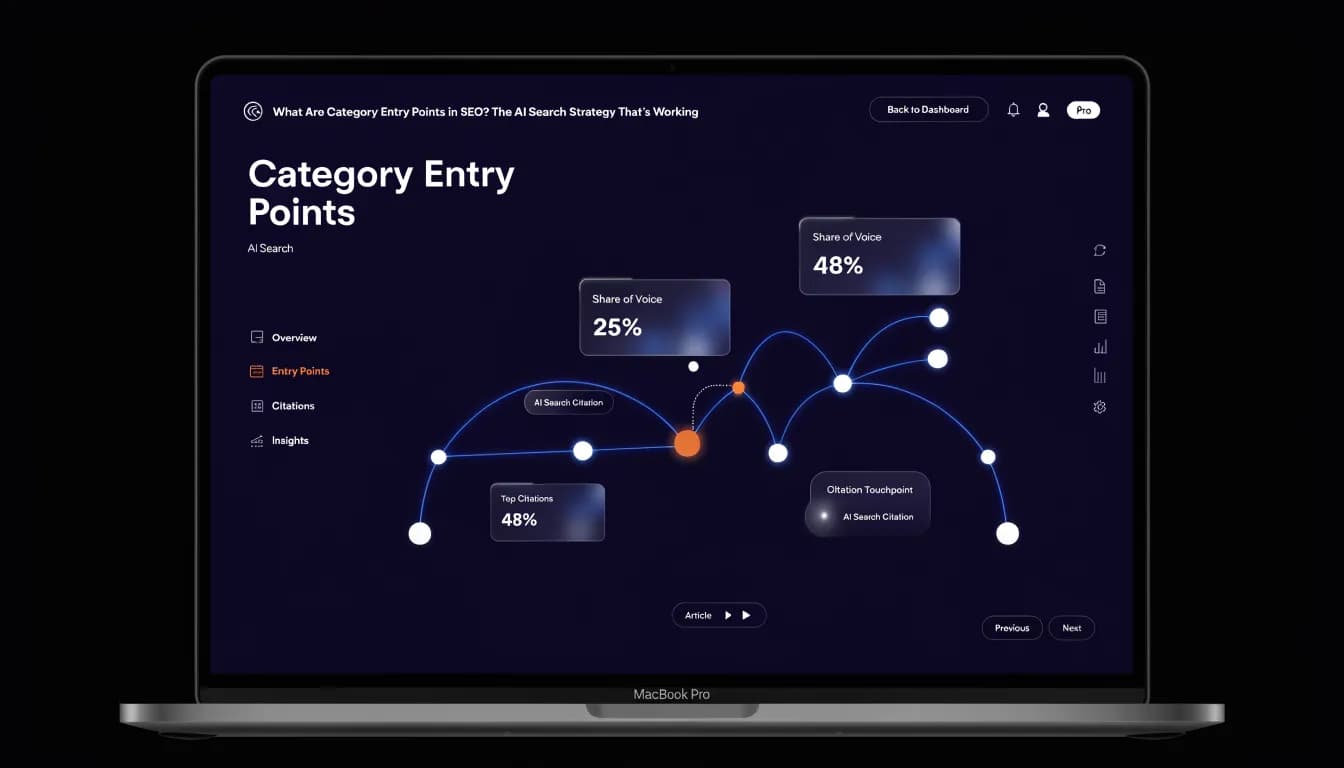
Semrush's AI visibility team published one article in June 2026 that got cited by AI every single week for four months. Not a keyword-optimized pillar page. Not a link-building campaign. One article, built around a specific situation their customers keep finding themselves in. The framework they used has a name — Category Entry Points — and it comes from marketing science, not SEO — and the SEO world only discovered it when AI search changed how content gets surfaced. Have you checked which AI platforms are citing your competitors right now — but not you? You probably have the prompts that should cite your content. Right now, something else is getting cited instead — and you won't find that problem in your keyword rankings.
What Are Category Entry Points (CEPs)?
Category Entry Points were defined by Byron Sharp in his 2010 book How Brands Grow, published by the Ehrenberg-Bass Institute for Marketing Science. The idea is precise: a CEP is a specific situation, occasion, or trigger that causes a buyer to mentally reach for a product category -- not a brand, not a product, just a category.
Fast food brands have researched this exhaustively. The CEP "quick lunch during a work day" triggers a different set of brand associations than "celebrating with kids on a Friday." Same restaurant category, different situations, different brands recalled. Sharp's research found that brands associated with more CEPs are recalled more often and chosen more often. Mental availability -- not brand awareness -- predicts purchase.
That principle, lifted directly from consumer behavior research, now describes exactly how AI models decide which content to cite.
The CEP in this case: "I've noticed my competitors showing up in AI answers and I'm not."
That situation maps to dozens of different prompt phrasings. One piece of content anchored to that CEP gets retrieved across all of them.
Why CEPs Work Differently for AI Search
Traditional SEO vs AEO for AI search is usually framed as a keyword vs. entity debate. CEPs add a third dimension: situations.
Here's why the distinction matters in practice. Google's organic algorithm rewards content that covers a topic comprehensively. More coverage, more keywords, more backlinks -- higher rankings. AI citation systems work differently. They reward content that matches the specific situation a user is in -- the exact context, phrasing, and implied need behind a prompt.
A topic-based article titled "How to improve your AI search visibility" competes with every piece of content about AI search visibility. A CEP-anchored article titled "Why are my competitors showing up in AI search and not us?" competes only with content that addresses that specific situation. Because fewer pieces exist for any given situation than for any given topic, the retrieval competition is thinner.
The compounding effect is what makes CEPs valuable at scale. When a piece of content matches a CEP, it gets retrieved for every prompt that encodes that situation -- not just the prompts that use similar keywords. One article, if properly anchored to a recurring situation, generates citations across a wide surface of prompt variation for months.
Semrush's experiment proved this distinction with hard data, which brings us to the numbers.

The Semrush CEP Experiment -- The Numbers
In June 2026, Zach Paruch (SEO strategist at Semrush) published the results of a controlled AI visibility experiment conducted using Semrush Enterprise AIO. The setup: 1,758 prompts tracked across three platforms -- ChatGPT, Google AI Overviews, and Google AI Mode -- measuring five metrics: citation volume, prompt breadth, model mix, share of voice (SOV), and brand mentions.
What Semrush published and what happened
Three articles were published simultaneously, each representing a different strategic approach. The CEP-anchored article was: "Why are my competitors showing up in AI search and not us?"
Article type | Approach | 4-month outcome |
|---|---|---|
CEP-anchored | Specific recurring situation | Weekly citations for 4+ months |
Topic concern | "AI Overviews traffic loss" | Cited but stopped after 5 weeks |
Wide breadth | "Catch up on AI search" | Cited across many prompts, didn't compound |
The share of voice data
In the week after the CEP article published:
- Semrush's share of voice: 15% to 26% (the cluster tracking "AI citing my site vs. third-party sources")
- Control: AI Overviews benchmark moved only 21% to 22% in the same week
- Brand mentions lift: ~30% increase within two weeks of publication
For context: an 11-percentage-point SOV jump in a single week, on a metric tracking AI citations specifically, is the kind of result most AI SEO tools can't even measure yet -- let alone produce.
Why the topic-concern article didn't compound
This is the distinction most summaries miss. The "AI Overviews traffic loss" article was published the same day as the top performer. It covered a relevant topic. It should have performed similarly. It didn't -- because, as Paruch noted, it was "built around a topic concern, not a CEP."
A topic concern is a problem framed as an abstract category. A CEP is a specific situation framed from the buyer's first-person perspective. The difference in retrieval is the difference between being a general reference and being the exact document an AI model associates with that moment.
Platform behavior patterns
Not all AI platforms cited content equally:
- Google AI Overviews drove the bulk of citations on compounding articles
- ChatGPT showed the most consistent week-over-week citation pattern
- Google AI Mode was the most volatile -- sometimes dominant, sometimes near-zero in the same week
This matters for measurement. If you're tracking CEP performance, you need visibility across all three platforms to get an accurate read.
How to Identify Your Category Entry Points
The traditional CEP discovery method -- surveys, focus groups, brand trackers -- is expensive and slow. There are faster ways that use data you likely already have.
Method 1: Map your buyers' recurring moments of frustration
CEPs are situations, which means they're usually preceded by a specific pain. For a B2B SaaS tool, your CEPs might look like:
- "My churn spiked and I can't tell if it's the product or the onboarding"
- "Our conversion rate dropped after we added more SKUs and I don't know why"
- "I think AI is taking my organic traffic but I can't prove it to my CMO"
Notice these aren't product features. They're moments. Specific, recurring, embarrassing moments that a buyer has likely experienced more than once.
Method 2: Pull AI prompt data
If you're tracking AI visibility (or starting to), pull the actual prompts where your brand -- or your competitors -- appear. Look for prompt clusters that share a common situation even if they use different words. Those clusters are your CEPs waiting to be named.
Only 14% of marketers currently track AI citations, while 43% call AI search a core strategy (Digital Applied, 2026). That gap is where your CEP opportunity lives -- your competitors almost certainly aren't doing this yet.
Method 3: Mine your existing content for under-anchored situations
Read your top 10 performing blog posts. Rephrase each one as a first-person situation: "I am a marketer who is currently experiencing X." If you can't rephrase it that way -- if it's a topic overview, a keyword guide, or a trend summary -- it's not CEP-anchored. It's a topic concern.
Method 4: Look at what search data actually says
Your vibe marketing strategy and agentic marketing approach content may already be touching on adjacent CEPs if they were written around practitioner situations rather than topic definitions. Check which of your content pieces drive long-tail conversational queries (visible in Search Console) -- those are your existing CEP anchors, even if you didn't call them that.
Each additional CEP association a brand builds can lift brand consideration by up to 15% in competitive categories, according to research cited in Marketing Week (Ehrenberg-Bass Institute). In B2B insurance, each extra CEP linked to a brand reduced churn probability by 5% (LinkedIn B2B Institute). The downstream commercial impact is real -- and the AI citation mechanics are the fastest available path to building those associations right now.

CEP Content vs. Traditional SEO Content
The structural differences between CEP-anchored content and traditional SEO content are specific enough to apply as a checklist.
Dimension | Traditional SEO content | CEP-anchored content |
|---|---|---|
Title format | Keyword-first, topic-led | Buyer's question in the exact situation |
Opening paragraph | Category definition or statistics | Acknowledges the situation directly -- no definition preamble |
H2 structure | Subtopics of the main keyword | Specific prompts that fall under the CEP |
Language register | Expert-to-audience | Peer-to-peer -- the same language the buyer uses in the prompt |
Primary goal | Keyword ranking | Prompt retrieval across all phrasings of the situation |
Performance decay | Gradual (6-18 months) | Compounds if CEP is recurring; decays fast if it's a one-time concern |
The most important shift is in the opening. Traditional SEO content opens with category education: "AI search visibility is the term used to describe..." CEP content opens mid-situation: "You've just pulled your Search Console report and noticed that a competitor who launched 6 months ago is getting AI citations you aren't." The reader is already inside the experience by the second sentence.
How to Build CEP-Anchored Content: Step-by-Step
Step 1: Name the situation precisely
Not "AI search challenges for marketers." Something your buyer would actually say: "I set up AI visibility tracking and I'm not sure what I'm supposed to do with the data." The more specific, the smaller the competition surface, and the more reliably your content will compound.
Step 2: Validate that the situation recurs
A CEP has to be a recurring situation -- not a one-time news event or a temporary concern. Semrush's data showed clearly that one-time concerns don't compound. Ask: will buyers still be in this situation in 6, 12, 24 months? If yes, it's a CEP. If it's tied to a platform update or a trend wave, it's a topic concern.
Step 3: Frame the title as the buyer's first-person question
The Semrush formula: "Why are my competitors showing up in AI search and not us?" -- not "Competitor AI search visibility" or "How AI search ranks content." The AI model retrieves based on situation match. Your title has to encode the situation, not just the topic.
Step 4: Mirror specific prompts in your H2s
Each H2 should be a specific prompt variation that falls under the same CEP. Under the CEP "discovering you're invisible in AI search," your H2s might be:
- "Why does [competitor] appear in AI answers about our category and we don't?"
- "How do I find out if AI is citing my content?"
- "What does it mean when ChatGPT mentions my competitor but not me?"
These H2s are the prompt breadth -- each one extends the retrieval surface of the article.
Step 5: Open with the situation, skip the definitions
Every CEP article should start by acknowledging the reader's current experience. Don't define the category. Don't explain what AI search is. The reader who is in that situation doesn't want the textbook intro -- they want to know you understand what's happening to them right now.
Step 6: Write in the language of the situation
The vocabulary your buyer uses in a ChatGPT prompt is not the vocabulary they use in a polished email. It's less formal, more specific, more frustrated. Your content should use that language -- because the retrieval mechanism is matching your content against prompt text, and prompt text is how people actually talk.
CEP Strategy with AI Marketing Tools
Finding and acting on CEPs at scale requires visibility data that most teams don't have access to today.
The basic workflow: track which prompts cite your content, identify the recurring situation behind each prompt cluster, find the gap CEPs where competitors are being cited and you're not, write the CEP article, measure whether it compounds across weeks.
Allable.ai (Free forever / Pro: $34/month / Business: $99/month) connects keyword tracking and AI visibility in one interface. The SEO module tracks which prompts are citing your content and which are citing competitors -- letting you identify the situation gaps before you write. If a cluster of prompts about "AI search competitors" consistently returns a competitor and never returns your site, that's a CEP gap. The system surfaces that without you manually checking each prompt variation in ChatGPT.
For teams running the CEP process manually, the minimum toolset is: Google Search Console (to find conversational long-tail queries you're already getting), a prompt-tracking tool for AI citation measurement, and a structured editorial process to write at the situation level, not the topic level. Allable handles all three in one workflow -- you're not stitching data from separate platforms.
The strategic goal, as Semrush's experiment shows, is to own the category-level situation before the category becomes crowded. That 21-day first-mover window cited in competitor intelligence reports isn't marketing hype -- it reflects how AI model citation patterns calcify. Early associations become default associations. Default associations compound. Everything else has to fight to break in.
CEPs in Action: 3 B2B SaaS Examples
Example 1: Project management tools
CEP: "My churn rate spiked this quarter and I can't tell if it's a product issue or an onboarding issue."
This situation recurs across every B2B SaaS company that has grown past 100 customers. It's not tied to a specific news event. It maps to dozens of prompt variations: "high churn rate reasons B2B," "how to diagnose customer churn," "churn spike after product update." A project management or customer success tool that publishes an article anchored to this exact situation -- told from the first-person perspective of the ops manager staring at the churn dashboard -- gets retrieved across all of those prompts.
Example 2: Analytics and CRO tools
CEP: "Our conversion rate dropped after we expanded the product catalog and nobody knows why."
E-commerce and product teams hit this repeatedly. The situation is specific (catalog expansion, conversion drop), recurring (happens every time a team scales SKUs), and emotionally specific (the "nobody knows why" is the honest frustration behind the situation). An analytics tool that owns this CEP gets cited whenever a buyer reaches for analytics context in that exact moment.
Example 3: AI visibility tools (this category)
CEP: "I think AI is taking my organic traffic, but I can't prove it to my CMO."
This is Allable's category entry point. The recurring situation: a marketer who has noticed the anomaly, has a hypothesis, but can't demonstrate it credibly without data. This CEP maps to prompts like "how to prove AI search is affecting my traffic," "AI search traffic loss evidence," "Google AI Overviews impact on organic clicks." A piece of content that starts inside this situation -- not with a definition of AI Overviews -- and gives the marketer the specific framework to build a CMO-ready case study gets retrieved every time a buyer is in this moment.
Frequently Asked Questions
- What's the difference between a CEP and a pillar page?
- A pillar page is organized around a topic and designed to rank for a broad keyword. A category entry point article is organized around a recurring situation and designed to be retrieved by AI models across the prompt variations that encode that situation. Pillar pages win at keyword coverage. CEP articles win at prompt retrieval. For AI search visibility, you need both -- but the logic is different. Pillar pages ask what does Google want to rank for this topic? CEP articles ask what situation is my buyer in when they reach for this category?
- Is this the same as topical authority?
- Topical authority is about breadth of keyword coverage within a topic cluster. CEPs are about depth of situational relevance for specific recurring moments. You can have strong topical authority and still get zero AI citations if your content isn't anchored to the situations behind the prompts. They're complementary, not equivalent. Building topical authority via traditional content clusters remains valuable -- but it won't automatically produce the compounding CEP effect that Semrush documented.
- How do you measure CEP performance for AI search?
- Track citations per prompt cluster week-over-week across ChatGPT, Google AI Overviews, and Google AI Mode. Look for: (1) whether citation rates compound or decay after week 5; (2) whether the same article appears across multiple prompt phrasings for the same CEP; (3) share of voice within the CEP's prompt cluster versus competitors. Citation volume alone isn't the signal -- compounding is. An article cited steadily for 4+ months is a compounding CEP anchor. An article cited for 5 weeks and then dropping is a one-time topic concern.
- How many CEPs should a brand try to own?
- Byron Sharp's research suggests that more CEP associations improve brand recall and purchase probability -- but there's a practical limit based on content quality. The compounding effect requires that each CEP article be genuinely well-anchored to its situation. In AI citations, a strong CEP anchor compounds for months, while a weak one stops after 5 weeks. Start with 3-5 CEPs that represent your most recurring, highest-stakes buyer situations, prove the compounding effect, then scale.
- How is CEP-anchored content different from Jobs-to-be-Done content?
- Jobs-to-be-Done (JTBD) identifies functional and emotional jobs a product helps buyers accomplish. CEPs identify the situational triggers that cause a buyer to reach for a product category. They're complementary frameworks. JTBD answers what are they trying to do? CEPs answer when and why do they reach for the category? For content strategy, CEPs are more actionable -- because they tell you what the buyer's prompt looks like in the moment they need your product, which is exactly what AI models are retrieving against.
- How do you find CEPs if you don't have brand tracker data?
- Start with your sales team. Ask them: What specific situation is the customer always in when they first contact us? The answer is usually remarkably consistent -- and remarkably specific. That recurring situation is your most important CEP. Then cross-reference with Search Console long-tail query data -- conversational queries (who/what/why/how do I) that already drive impressions to your site often encode CEPs that buyers are actively searching. Finally, manually test 10-15 prompts in ChatGPT that represent plausible buyer situations in your category. Where competitors appear and you don't -- that's your CEP gap queue.