AI Visibility Audit: How to Check Where Your Brand Appears in AI Search (And Fix the Gaps)
 Written by Martin J.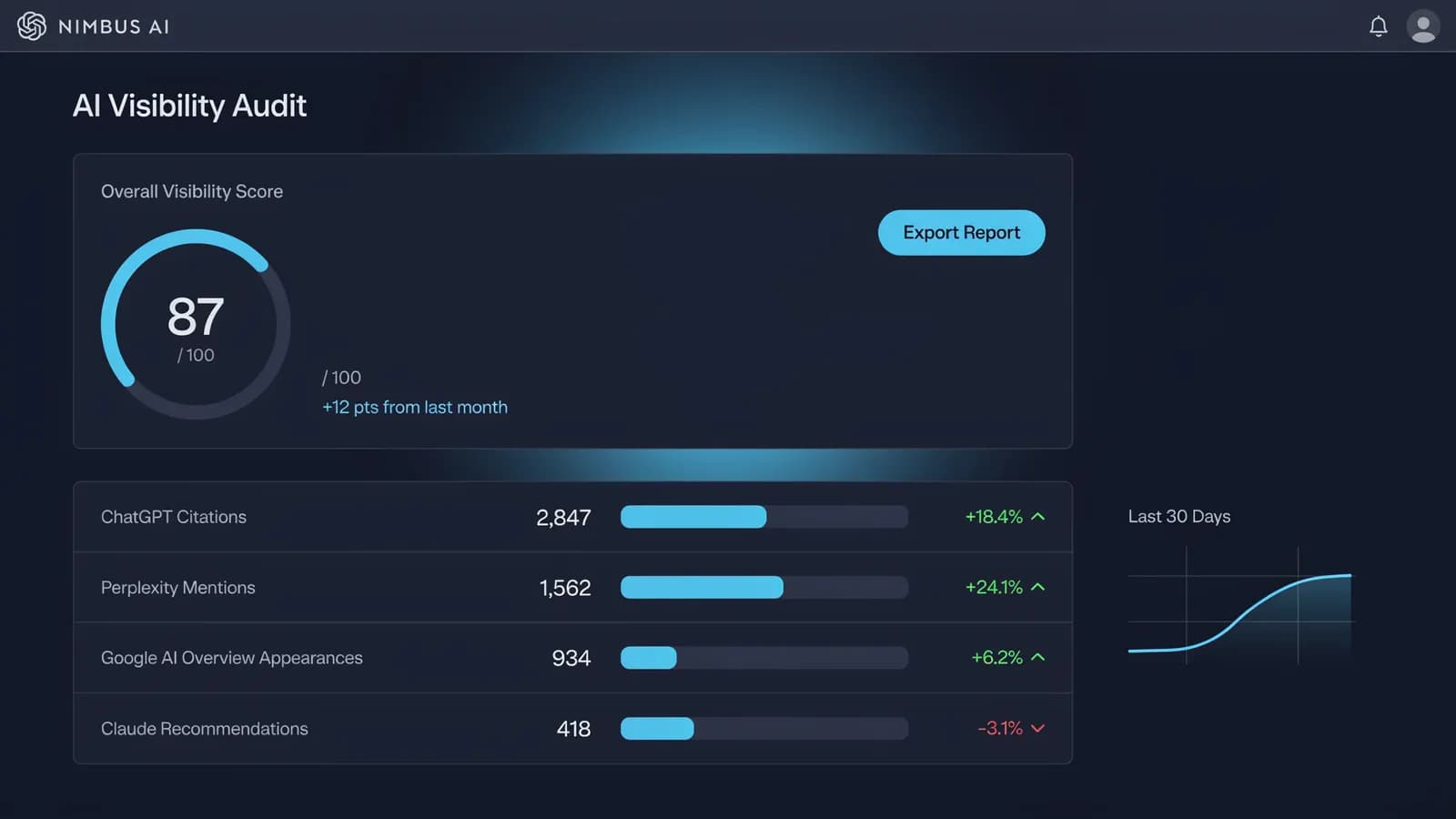
You've been building content for Google. Optimizing for rankings, tracking impressions in Search Console, adjusting titles based on click-through data — and it's been working. Meanwhile, a version of your brand is being described in ChatGPT, Perplexity, and Google AI Overviews dozens of times a day, and you've never seen that transcript. It's either accurate, outdated, or a competitor is being recommended in your place. Without running an AI visibility audit, you genuinely have no way to know which it is. Has your brand ever appeared as the top recommendation in a ChatGPT answer about your category? Do you know what Perplexity says when a buyer asks for tools like yours? If you can't answer those questions, you're making content investment decisions based on half the picture.
Your SEO dashboards are green. Traffic is holding. Rankings look fine. But right now, thousands of people in your target market are asking AI tools questions that your content should be answering — and your brand isn't mentioned once. Not because your content is bad. Because AI search operates on completely different rules than Google, and almost no one has thought to audit it yet.
That gap is growing every month, and there's no Search Console report alerting you to it. You're optimizing for a metric that covers maybe 60–70% of the search landscape. The rest? Invisible by default.

What Is an AI Visibility Audit?
An AI visibility audit is a structured process for measuring how often — and how accurately — AI-powered search tools mention, cite, or recommend your brand when users ask questions in your space.
It's not the same as a traditional SEO audit. Your standard audit tells you how your pages rank in Google. An AI visibility audit tells you something different: what ChatGPT says when someone asks "what's the best tool for [your category]?" What Perplexity cites when a buyer is researching alternatives to your competitor. What Google AI Overviews show when someone searches for the problem your product solves.
Those are different reports. And right now, you probably only have one of them.
The three things an AI visibility audit measures:
- Presence — Does your brand appear at all in AI-generated answers to queries in your category?
- Accuracy — When you do appear, are you described correctly? Outdated product descriptions and wrong positioning actively hurt conversions.
- Competitive share of voice — Relative to your top 3–5 competitors, are you appearing more or less often? Are they being cited while your content goes unmentioned?
When should you run one? The obvious triggers: a noticeable traffic drop that doesn't correlate with rank changes, a competitor launching a major content push, or any significant AI feature release from Google, OpenAI, or Anthropic. But the real answer is monthly — because AI search results change continuously and the only way to track your trajectory is consistent measurement over time.
Step 1 — Define Your Audit Prompts
The quality of your audit depends entirely on the quality of your prompts. Generic queries return generic signals. Your prompt set should reflect how your actual buyers talk about your category — not how you would describe it.
Build your prompt set in three buckets:
Category prompts — These are the queries your ICP types when they're in research mode, not yet brand-aware. "Best tools for AI-powered SEO." "How do I audit my organic traffic." "What should I use for keyword research in 2026." Run 8–10 of these.
Brand prompts — These test how AI describes you directly. "What is [your brand]?" "[Your brand] pricing." "[Your brand] review." "[Your brand] vs [top competitor]." Run 5–7 of these.
Problem-first prompts — These simulate your buyer's thinking before they know what category they're looking for. "How do I know if my content is showing up in AI search?" "Why is my branded traffic dropping?" "What's the difference between SEO and GEO?" Run 5–8 of these.
Total: 20–25 prompts is the right starting point for most teams. Too few and you'll miss category-level patterns. Too many and you won't run the audit consistently each month.
Step 2 — Run Your Prompts Across AI Platforms
For each prompt, test it across the platforms your buyers actually use. Here's how to prioritize:
Google AI Overviews — Highest query volume and most direct SEO overlap. Use incognito mode while logged out to get unpersonalized results. Google AI Overviews now appear in roughly 15–20% of US search queries, and that figure is significantly higher for commercial and informational queries in marketing and SaaS categories.
ChatGPT (GPT-4o) — The platform where brand perception is being shaped for marketing professionals, agency teams, and technology buyers. Over 100 million weekly active users as of 2024, with a growing share using it as a primary research tool rather than a conversational assistant.
Perplexity — The most citation-transparent major AI tool. Because Perplexity shows its sources explicitly, it gives you the clearest read on which pages AI is treating as authoritative in your category. Its audience skews toward technically sophisticated buyers — exactly the early adopters and research-heavy decision-makers in your funnel.
Claude (Anthropic) — Growing fast in enterprise and professional contexts. Worth including if your buyers are in larger organizations or use Claude via their internal tooling.
Google AI Mode — Google's dedicated AI search panel (separate from AI Overviews) provides longer, more detailed responses with 15+ source references per query. Still new, but represents where Google is pointing the future of search. Content that earns citations in AI Mode tends to be highly structured and factually dense.
For each prompt on each platform, log four things in a spreadsheet: brand mentioned (yes/no), position in the response (early / middle / buried), description accuracy (accurate / partial / wrong / absent), and cited URL if any.
Step 3 — Score Your AI Visibility
After running your prompt set, you have raw data. Here's the scoring framework:
Brand mention rate — Out of your full prompt set, what percentage of responses mentioned your brand at least once? Below 15% signals a serious gap for an established brand. 15–35% is typical for mid-market brands. Above 50% means your content strategy is already well-aligned with AI retrieval patterns.
Citation rate — Of all responses where you appeared, what percentage included a source link back to your content? A low citation rate alongside a higher mention rate means AI tools are referencing your brand from training data — not from your live pages. That's a structural problem: it means your content isn't being treated as a primary source.
Competitive gap — Run the same prompt set for your top 3–5 competitors. If the leader has a mention rate 2× or more than yours, that gap is measurable and actionable. It tells you there's a content authority deficit large enough to run a focused sprint on.
Description accuracy — When AI tools describe your brand, is the description current? Common problems: outdated pricing, wrong use case descriptions, missing product features, misattributed positioning. These are high-priority fixes because inaccurate AI descriptions do active reputational damage before buyers ever reach your site.
Step 4 — Identify the Gaps
This is where your audit becomes a content plan.
For every prompt where your brand didn't appear, ask one question: does your brand actually have content that should be answering this query? Two possible answers, two different responses.
If yes, content exists but didn't surface: The problem is content depth, structural clarity, or authority. Your page might be ranking in Google but not dense enough factually for AI retrieval, or structured in a way that doesn't parse well in LLM contexts. These pages need a rewrite with a specific focus on verifiable claims, direct answers, and structured formatting.
If no, content doesn't exist: You've just identified a direct content opportunity. A prompt that generates zero results for your brand is a brief waiting to be written.
Look for patterns across your gap prompts — you'll typically find 2–3 topic clusters where your AI presence is consistently weak. Those clusters are your highest-leverage content investment. One well-structured, factually dense guide that becomes the authoritative source on a topic can shift your AI citation rate on a whole cluster of related prompts.
Also flag any queries where your brand appears with inaccurate descriptions. These require different fixes than content gaps — often a combination of publishing clearer positioning pages and getting third-party sources to describe you more accurately.
Step 5 — Fix Your AI Visibility Gaps
Knowing your gaps is only useful if you act on them. Here are the four fix categories, in order of impact:
Content fixes — Publish pages that directly answer the prompts where you're missing. Not thin "answer the question" pages — but substantive, factually dense content that AI tools can pull from. For understanding what formats AI tools consistently cite, the best AI visibility tools guide covers which content types perform strongest in AI retrieval.
Authority fixes — AI tools give significant weight to third-party signals: review sites, industry publications, analyst coverage, and what other trusted sources say about your brand. If your competitors are being cited and you're not, the gap is often less about your content and more about your external authority footprint. Getting reviewed on G2, Capterra, or by industry analysts who AI tools treat as authoritative sources moves the needle faster than publishing 10 more blog posts.
Structured data fixes — Schema markup helps AI tools parse your content correctly. For AI-specific visibility, llms.txt is emerging as a standard — a structured declaration on your domain that tells AI crawlers what your brand is, what you do, and which pages represent your most authoritative content. Not yet universal, but worth implementing now as early adopters establish the pattern.
Monitoring fixes — Set up automated tracking so you're not running manual audits every month. This is where the manual process breaks down at scale: 25 prompts x 4 platforms x monthly cadence = 3–4 hours of work per cycle. Tools purpose-built for AI visibility tracking — Allable, Profound, and a small number of others — turn that into an automated dashboard you review rather than a manual process you execute.
If you're evaluating AI visibility tools specifically, the Profound alternatives comparison breaks down how the major options differ on methodology, platform coverage, and reporting structure.
AI Visibility Audit Tools
Three categories of tooling exist for running AI visibility audits:
Purpose-built AI visibility platforms — Allable, Profound, and a handful of emerging tools are built specifically to track brand presence across AI search channels. They automate the prompt-running process, track changes over time, and surface competitor comparisons. This is the right category if you need to run audits at scale or across multiple clients.
Manual process (spreadsheet + browser) — Viable for small teams running monthly audits on a limited prompt set. No cost, full control, but time-intensive and difficult to track trends reliably over time.
Traditional SEO tools with AI overlays — Some established SEO platforms are adding AI visibility features. These vary widely in how they define "AI visibility" and which platforms they actually track. Verify methodology before committing.
For a full breakdown of what each tool actually measures — and where the methodology differences matter for your specific use case — the best AI visibility tools comparison covers the major options in detail.
Martin Janeček is the CEO of Allable.ai, an AI-powered marketing platform that replaces Semrush, Jasper, and Surfer SEO with a single chat-first interface.
Frequently Asked Questions
- How often should I run an AI visibility audit?
- Monthly is the right default cadence for most marketing teams. AI search results change continuously — as models update, as new content gets indexed, and as competitor content strategies shift. Monthly snapshots give you enough data to identify trends without creating audit fatigue. If you're in a rapidly evolving category or mid-way through a content sprint, bi-weekly checks on your highest-priority prompts make sense.
- Does improving my Google SEO automatically improve my AI visibility?
- Partially, but not reliably. Google AI Overviews pull from Google's index, so ranking well does improve your chances of appearing in that AI channel. But ChatGPT and Perplexity use different sources and different weighting signals. A page ranking #2 in Google might never appear in ChatGPT's answers if it lacks factual density or isn't being cited by third-party sources AI tools treat as authoritative. You need to optimize for AI retrieval separately — not instead of traditional SEO, but alongside it.
- What's the fastest way to improve my AI visibility score?
- The highest-leverage moves: publish content with specific, verifiable factual claims (statistics, original research, concrete comparisons); increase your external authority footprint (get reviewed on sites AI tools treat as authoritative sources); and make sure your brand's key differentiators are stated clearly on your owned pages. Vague positioning does not get cited. Specific positioning — 'we reduce manual SEO reporting time by 70% for agency teams managing 20+ clients' — does.
- What's the difference between AI visibility and GEO?
- GEO (Generative Engine Optimization) is the umbrella term for optimizing your content to be retrieved and cited by generative AI tools. An AI visibility audit is the diagnostic step within a GEO strategy — it measures your current state so you know where to focus your optimization efforts. The relationship is the same as a traditional SEO audit to an SEO strategy: the audit tells you what's happening; GEO is the set of practices you apply to improve the outcome. For more on how these two concepts relate, see our guide to AEO vs GEO.
- Which AI platform should I prioritize when resources are limited?
- Google AI Overviews, because it has the highest query volume and the most direct connection to your existing SEO infrastructure. But don't stop there — ChatGPT is where brand perception is being formed for your most influential buyers. If you can only track two platforms manually, do Google AI Overviews and ChatGPT. Add Perplexity third because its explicit citations give you the clearest signal of what content AI tools are treating as authoritative in your space.
- Does Allable's AI visibility tracking work for agencies managing multiple clients?
- Yes. The Business plan at 91/month supports multi-client tracking with separate prompt sets and dashboards per account. Most agency teams set up a standard prompt template by industry vertical and adapt it per client — Allable supports that directly. You can run audits on a defined schedule and export structured reports per client.
How Allable Measures Your AI Visibility Automatically
Allable's AI visibility module automates the full audit process. You define your prompt set once — Allable runs checks across Google AI Overviews, Google AI Mode, and ChatGPT, returns structured results with mention rate, citation rate, and competitor comparison, and tracks changes between runs. A 3-hour manual process becomes a 20-minute data review.