AI Orchestration for Marketing: How to Coordinate Multiple AI Agents Without the Chaos
 Written by Martin J.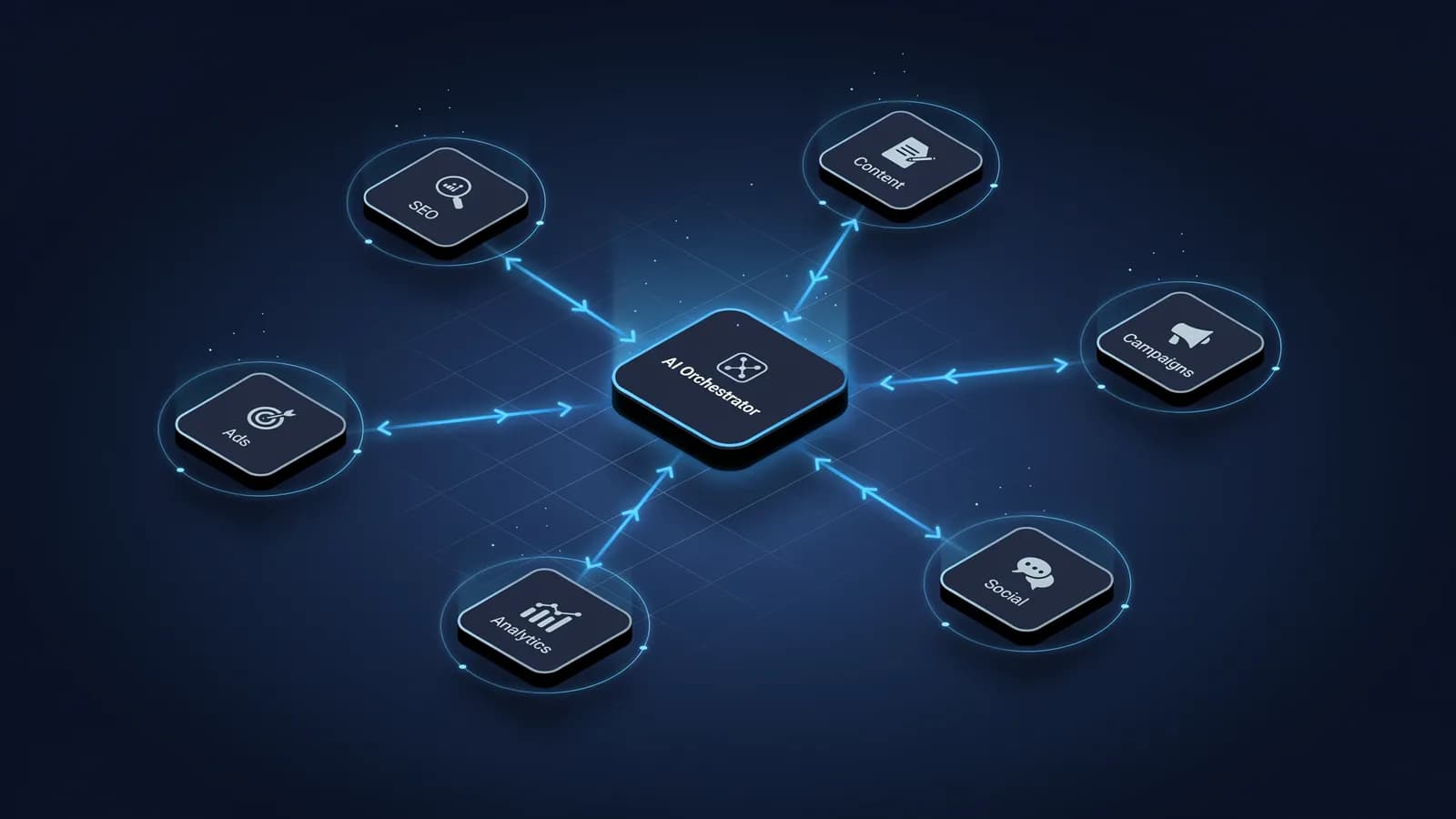
You hired five AI tools last quarter. Each one works. Your team is still copy-pasting outputs between them at 10pm on a Tuesday. What exactly does your AI stack coordinate — and what is it just handing off to a human? That gap has a name. Most teams don't realize they have an orchestration problem — they think they have a tools problem.
What Is AI Orchestration for Marketing
AI orchestration is the coordination layer that allows multiple AI models, agents, and tools to work together on complex, multi-step marketing tasks — sharing context, passing outputs, and adapting in real time.

Here’s the distinction that actually matters: automation follows fixed rules. You build a Zapier workflow, it runs the same steps every time. Great for repetitive, predictable tasks. Useless when conditions change, content quality matters, or one agent needs to know what another just decided.
Orchestration is dynamic. An orchestrator layer monitors what each agent is doing, routes outputs to the right next step, manages shared memory, and adjusts when something breaks or produces unexpected results. It’s closer to a project manager than a conveyor belt.
In marketing, this plays out in practical terms: your SEO research agent passes keyword clusters to your content briefing agent, which passes a brief to your writing agent, which triggers a review — all with the original research context intact, not pasted into a new chat window. Each step knows what happened before it.
That’s the difference between having AI tools and having an AI-coordinated marketing operation.
How AI Marketing Automation Becomes Orchestration: The Core Components
Most teams are already using some form of AI marketing automation — scheduling tools, content generators, reporting dashboards. Orchestration is what turns that stack into a system.
Four components make the difference:
1. The Orchestrator Layer
This is the decision-making core. It takes a high-level goal (“produce three optimized blog drafts this week”) and breaks it into tasks, assigns each to the right agent, and monitors progress. Without this layer, your agents are isolated. With it, they become a coordinated pipeline.
2. Shared Memory and Context Management
This is where most AI stacks break. Agent A completes keyword research. Agent B starts writing. Agent B has no idea what Agent A found.
Proper orchestration means context — brand voice guidelines, competitive findings, approved keywords, previously published content — is available to every agent at every step. A centralized memory layer, not repeated manual prompting, makes this possible.
3. Tool and Data Integrations
An orchestrated marketing system connects to your actual data: your CMS, your analytics, your ad accounts, your SEO tools. Agents pull live information and push finished outputs directly — they don’t wait for a human to act as the connector.
4. Feedback Loops
This separates orchestration from a more sophisticated automation. After a campaign goes live, your orchestration system pulls performance data and feeds it back: what copy outperformed, which keywords are gaining traction, where spend is inefficient. Agents adjust future decisions based on real outcomes, not assumptions.
These four components together are what Gartner estimates will be standard in 80% of enterprise software by the end of 2026 — not as a feature, but as the foundational layer how AI delivers value in complex workflows.
Why Traditional Marketing Automation Falls Short
You’ve probably already experienced this. You set up a workflow in Make.com or Zapier. It runs. Something unexpected happens — a content brief comes back in the wrong format, a keyword data pull returns an empty set, a campaign target changes — and the whole workflow stalls or produces garbage.
Traditional automation assumes:
- Inputs are predictable
- Steps are linear
- Humans will fix the exceptions
AI-orchestrated marketing assumes the opposite. Inputs vary. Steps branch. Agents handle exceptions by adapting in real time, escalating to a human only when genuinely needed.
The other gap is context loss. A Zapier workflow passes a value from step A to step B. It doesn’t pass understanding. Your content agent doesn’t know the competitive landscape your research agent mapped. Your campaign agent doesn’t know the brand voice guidelines your strategy team approved last month.
McKinsey data shows marketing teams using AI orchestration — where agents share context and adapt dynamically — report 40% faster campaign iteration compared to teams using siloed AI tools or basic automation. That gap compounds over time. Faster iteration means more experiments, more learning, better results.
The teams not closing that gap in the next 12 months will feel it.
The 5 Key Use Cases for AI Orchestration in Marketing
Here’s where orchestration moves from concept to competitive advantage for your team. These are the five use cases where a coordinated multi-agent system outperforms any single tool — and where your competitors are already pulling ahead if they’ve made the transition.
1. Content Pipeline at Scale
Instead of one AI tool generating one piece of content at a time, an orchestrated pipeline handles the entire lifecycle: keyword research → competitive gap analysis → brief generation → draft → SEO review → publish-ready formatting — with each stage informed by the previous one. No manual handoffs. No context loss between steps.
2. Campaign Optimization in Real Time
Your ad copy, your audience segments, your bid strategies — they’re all connected by data your agents can access. An orchestrated system monitors campaign performance, identifies underperforming variations, generates and tests new copy, and surfaces recommendations without waiting for a weekly review meeting. Your campaigns improve continuously, not in quarterly bursts.
3. Competitive Intelligence That Feeds Strategy
Competitor monitoring isn’t useful if it’s disconnected from planning. Orchestrated agents crawl competitor content, detect new angles and keyword opportunities, cross-reference your existing coverage, and feed gaps directly into your content brief queue. What was a manual research exercise becomes a continuous signal — your strategy responds to the market in days, not months.
4. Personalization at Scale
Personalization fails when it’s treated as a content problem. It’s actually a context problem: your content agent needs to know which segment it’s writing for, what that segment has already seen, and what message is currently performing. Orchestration connects audience data to content decisions at the moment they’re made — not as a retrospective segmentation exercise.
5. SEO + Content Aligned from the Start
SEO research and content writing are still siloed in most teams. The SEO specialist finds the keywords, exports a spreadsheet, sends it to the content team, and waits. Two weeks later, the draft comes back with half the keywords missing.
In an orchestrated system, the SEO research layer and the content generation layer are the same pipeline. Keywords, SERP analysis, competitor content gaps, internal link opportunities — all of it travels with the brief through every stage of production. What you get isn’t just optimized content; it’s content that was built with SEO context from the first word. If you want the full picture of how this works at the keyword level, the guide on the what is agentic marketing covers what the research layer needs to include.
Marketing AI Agents: How Specialized Agents Divide and Conquer
The phrase “marketing AI agents” gets used loosely. In an orchestration context, it has a specific meaning: a specialized agent is built to do one thing well and hand off cleanly to the next.
Here’s what a real multi-agent marketing architecture looks like in practice:
- Research agent — maps the competitive landscape, validates keyword opportunities, identifies SERP gaps
- Brief agent — translates research into structured content briefs with SEO requirements, tone guidelines, competitive angle
- Writing agent — produces drafts anchored in the brief and research context, not starting from a blank prompt
- Review agent — checks output against brand voice, checks for factual claims, flags structural issues
- Publishing agent — handles formatting, CMS upload, internal link insertion, image placement
- Analytics agent — monitors post-publish performance and feeds results back into the research layer
None of these agents is doing what a Swiss Army knife AI assistant does. Each is narrow, fast, and good at one thing. The orchestration layer — the part that connects them, passes context, and manages failures — is what makes them collectively more valuable than the sum of their parts.
This is why platform comparisons based on “which AI model is best” miss the point. The model matters less than the architecture. A mid-tier model in a well-orchestrated pipeline consistently outperforms a frontier model used in isolation.
For a broader look at how agentic approaches are reshaping marketing operations, the piece on what is agentic marketing gives the strategic context that sits above the tooling layer.
How to Implement AI Orchestration: A Practical Framework
The biggest mistake teams make is trying to orchestrate everything at once. Start narrow. Prove the pattern. Expand.
Phase 1: Identify One High-Friction Workflow
Pick the workflow your team complains about most. Usually this is the content production pipeline (research → brief → draft → review) or the campaign reporting cycle. The goal of Phase 1 is not to build the perfect system — it’s to understand where context currently gets lost and where the most time is wasted on handoffs.
Phase 2: Define Your Memory Layer
Before you connect any agents, decide what context every agent needs. Brand voice document. Approved keyword list. Competitor positioning. Content calendar. These aren’t inputs to individual tools — they’re shared knowledge your entire system reads from.
This step gets skipped in most implementations. It’s why those implementations fail. Your agents are only as aligned as the context they share.
Phase 3: Build the Pipeline, Not the Agents
Most marketing teams already have AI tools. The work isn’t building new agents from scratch — it’s connecting existing tools into a defined pipeline with clear handoff points. Tool A produces output in format X. Tool B accepts format X. The orchestration layer routes, translates where needed, and flags failures.
If you’re using dev-heavy platforms like n8n or Make.com, you already know this step is where non-technical teams lose hours. Marketing-native orchestration platforms remove the pipeline-building friction entirely.
Phase 4: Add Feedback Loops
Once your pipeline runs reliably, close the loop. Connect your analytics to your research layer. Let campaign performance data inform future briefs. Let content performance signal which topics to expand and which to consolidate.
This is the step that turns a time-saving workflow into a learning system.
Phase 5: Expand to Adjacent Workflows
Once one pipeline works, the pattern replicates quickly. The memory layer you built in Phase 2 is already shared infrastructure. Each new workflow costs less to build than the last.
Teams that follow this sequence consistently reach full marketing orchestration in 60–90 days — starting from a single automated pipeline. Teams that try to orchestrate everything simultaneously rarely finish any of it.
Allable.ai: Marketing-Native AI Orchestration Without the Dev Setup
Most orchestration platforms are built for developers who understand marketing, not marketing professionals who want to use AI seriously. n8n, Dify, Make.com — powerful, but you’re building the plumbing yourself. Jasper, Copy.ai, Writer.com — they cover the content layer, not the orchestration layer.
Allable.ai was built from the opposite direction: start with what marketing teams actually do, then build the AI coordination around those workflows.
The platform runs a multi-agent pipeline natively: research agents, content agents, SEO agents, competitive intelligence agents, campaign agents. They share context through a centralized memory layer — your brand voice, your keyword database, your competitor intelligence, your content history — so every agent has the full picture without you prompting it each time.
Practically, this means:
- A brief generated this morning already knows what your competitors published last week
- A draft started today already has your approved keyword list from the SEO layer
- A campaign review already has the performance context from previous runs
No copy-pasting between tools. No manual syncing of research outputs. No starting from scratch each time a new agent enters the workflow.
Allable.ai is available on a Free plan (forever), with Pro at €31/month for teams that need full pipeline access, and Business at €91/month for agencies and larger marketing operations. The governance and AI policy controls relevant to marketing teams running orchestrated pipelines are covered in the AI governance tools guide — worth reading before you scale any automated workflow.
Frequently Asked Questions
- What Is AI Orchestration and How Does It Differ from Automation?
- AI orchestration is the coordination of multiple AI agents or models to complete complex, multi-step tasks — where each agent shares context, adapts to upstream outputs, and hands off results downstream. Automation runs fixed, pre-defined steps in sequence. Orchestration is dynamic: it adjusts when conditions change, manages context across agents, and handles exceptions without human intervention. The core difference is context awareness. An automated workflow passes a value from step A to step B. An orchestrated system passes understanding.
- What Is an Agentic Marketing Platform?
- An agentic marketing platform is a system where specialized AI agents handle distinct marketing functions — research, content, SEO, campaigns, analytics — and coordinate through a shared orchestration layer. Unlike AI-powered tools that augment individual tasks, an agentic platform runs multi-step workflows autonomously, with agents making decisions, passing context, and adapting based on real data. The distinction matters practically: an agentic platform reduces the human coordination burden across the full marketing workflow, not just within a single task.
- How Does AI Workflow Automation in Marketing Actually Work?
- In practice, AI workflow automation in marketing means a defined pipeline where each step triggers the next, with AI handling the actual work at each stage. A typical content pipeline: keyword research agent identifies opportunities → brief agent structures a content plan → writing agent drafts based on the brief → review agent checks brand alignment → publishing agent formats and uploads. Each stage uses the outputs of the previous stage as input. In a basic automation, these steps run in sequence with fixed inputs. In an orchestrated workflow, they share a memory layer so context flows between stages, and agents can adapt when inputs change.
Start Building Your Marketing Orchestration Layer
Allable.ai is built for marketing teams that want the output of a full marketing operation without the headcount. Multi-agent pipelines, shared context, no dev setup required.