
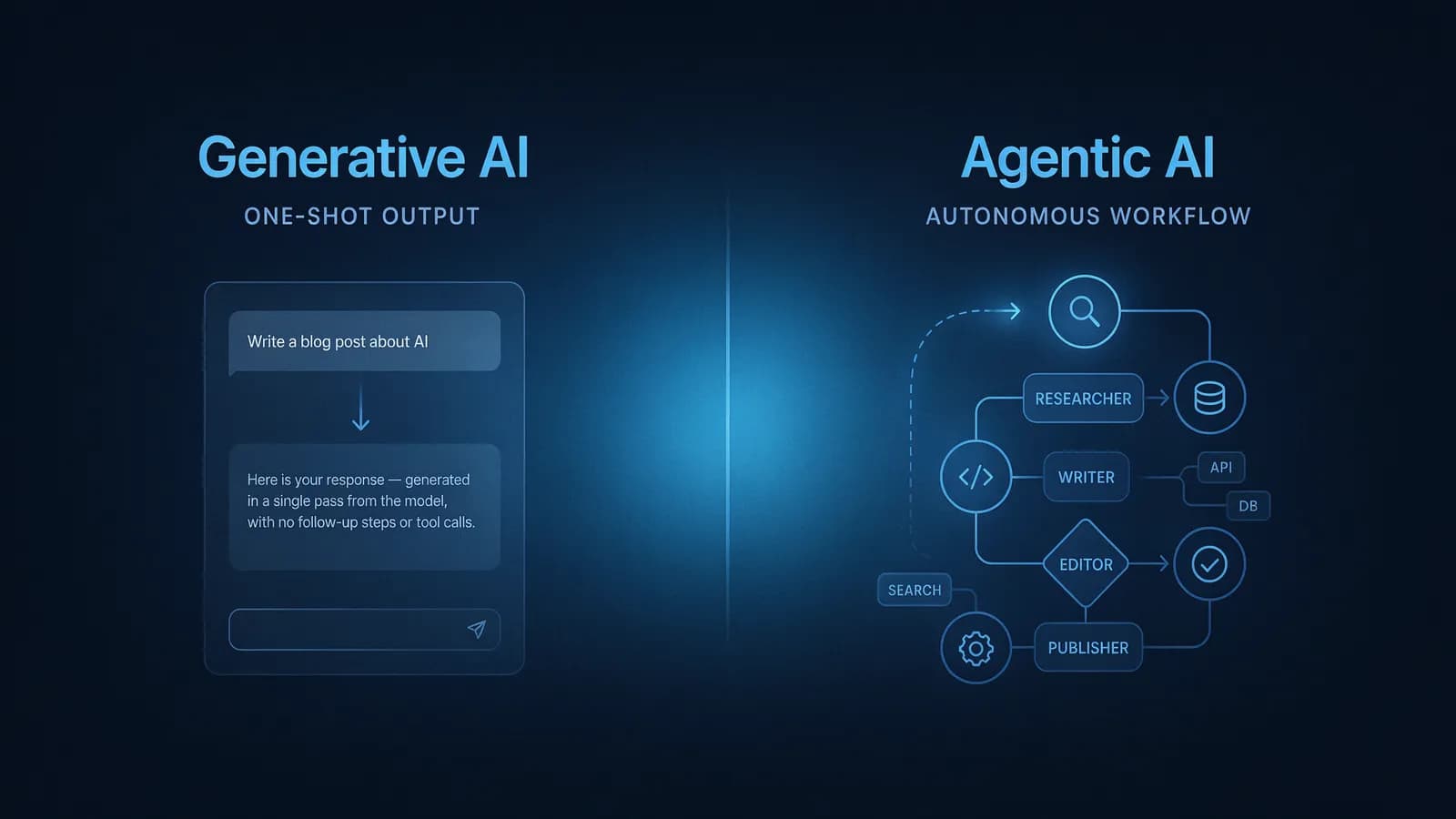
The tools sold to you as 'AI-powered' in 2023 and 2024 were, almost without exception, generative AI in a marketing costume. Faster copy, yes. But the decisions, the handoffs, the execution — still yours, every time. That's the paradox no vendor mentioned: you added more AI and ended up spending more time at the seams between tools, not less. Agentic AI is a different category — it pursues goals, executes steps, and keeps moving without you in the loop for each one. The gap between the two is not a feature difference. So why does your marketing stack feel exactly the same as it did two years ago?
You've been using AI in your marketing stack for over a year. Your output doubled. Your team is faster. And yet — the one thing that keeps breaking is the part where the work actually has to continue after the AI responds. The brief is generated, but someone still has to run the campaign. The copy is ready, but someone still has to publish, test, and optimize. Here's the paradox: the more AI you added to your workflow, the more handoff work you created for yourself. You're not less busy. You're busy differently — and mostly at the seams between tools.
Sixty-five percent of marketers still conflate what generative AI and agentic AI can actually do for them, according to HubSpot's 2025 Marketing AI Survey. That's not a knowledge gap. That's a framing problem — and it's costing teams real execution time every week.
What Is Generative AI in Marketing?
Generative AI is the technology behind every tool that creates content from a prompt. You write an instruction — "write a blog intro about email open rates" — and the model generates text, image, code, or data that didn't exist before. GPT-4, Claude, Gemini, Midjourney, DALL-E: all generative.

In marketing, generative AI accelerates the production layer. McKinsey's 2024 research found that teams using generative AI cut content creation time by 50–70%. That's real. A brief that took three hours now takes 40 minutes. A social media calendar that required a full afternoon gets a solid draft in 20 minutes.
What generative AI does not do is act. It waits. You come to it with a request. It responds. You take the output and decide what happens next. Every step of execution — briefing the AI, reviewing the output, pasting it into the CMS, scheduling the post, checking analytics two weeks later — stays with you.
Generative AI is your best copywriter who never sleeps, never complains, and never starts anything without being asked.
That is both its strength and its ceiling.
What Is Agentic AI?
Agentic AI is AI that acts without being prompted for each step. Instead of responding to a single instruction and stopping, an agentic system receives a goal and then breaks it down, executes the steps, evaluates the results, and iterates — all on its own.
The term "agentic" comes from the concept of agency: the capacity to take action independently. An agentic AI system doesn't just generate. It plans, calls tools, reads outputs, adjusts behavior, and keeps running until the goal is achieved or it hits a defined stopping condition.
For marketing, this changes the fundamental unit of work. Instead of "AI writes the copy, you do everything else," you get "AI researches the keyword, writes the brief, generates variants, tests them against a rubric, selects the best, and schedules it" — all as one continuous operation.
Gartner estimates that agentic AI systems can handle up to 90% of multi-step marketing workflows without human intervention. That's not a small difference from generative AI. That's a different category of tool.
What agentic AI looks like in practice:
- A system that receives a campaign goal on Monday and returns a published, distributed content set by Thursday — with ranking strategy, copy, images, and internal links already wired
- An agent that monitors your organic traffic daily, detects a page dropping in position, audits the content against current SERP, rewrites the underperforming sections, and flags you for approval before publishing the refresh
- An ai agents for marketing workflow that takes a competitor's new product announcement and automatically produces comparison content, ad copy variants, and a distribution brief — without you initiating each step
If generative AI multiplied your output per hour, agentic AI multiplies the hours you don't have to spend.
Generative AI vs Agentic AI: The Real Difference
This is where most comparisons get too technical. Here's what actually matters for your marketing operation:
| Generative AI | Agentic AI |
|---|---|---|
How it works | Responds to a prompt, stops | Sets a goal, executes multiple steps autonomously |
Trigger | You prompt it every time | You set it once; it runs on conditions or schedule |
Output | Content, code, data | Completed workflows, decisions, published work |
Human involvement | Required between every step | Required at goal-setting and approval gates |
Best for | Accelerating creation tasks | Automating end-to-end marketing processes |
Example | "Write five subject line variants" | "Run A/B subject line test, pick winner, send follow-up sequence" |
Learning | Stateless (no memory between prompts by default) | Stateful (tracks context, results, adjusts next actions) |
Risk profile | Low (you review before anything happens) | Medium (acts autonomously — guardrails matter) |
The clearest way to frame the difference: generative AI improves what you produce. Agentic AI changes what you have to do yourself.
Both are genuinely useful. Neither replaces the other. The teams getting maximum value right now are using generative AI inside agentic workflows — fast content generation as one step inside a larger autonomous process.
When to Use Generative AI vs Agentic AI in Your Marketing Stack
The honest answer is that most marketing teams should be using both — but for different layers of work.
Use generative AI when:
- You need a specific creative output fast — a headline, a brief, an email, an image
- The task is well-defined enough to evaluate in a single review pass
- You want full control over tone, positioning, and messaging on a per-piece basis
- The stakes are high enough that every output needs a human judgment call before it leaves the building
Generative AI is the right tool for any task where your expertise, taste, and brand judgment should be in the loop at the output level. Product launch copy, campaign messaging, brand storytelling — these are places where you want generative speed with human final call.
Use agentic AI when:
- The work involves multiple steps that currently require you to handoff between tools, tabs, and team members
- The same type of task repeats on a cadence (weekly content, monthly reports, daily social)
- You're spending more time coordinating work than doing it — briefing writers, chasing approvals, monitoring dashboards
- The feedback loop is measurable (traffic, rankings, engagement) and the AI can learn from the signal
Agentic AI is the right layer for your operational marketing — the things that have to happen whether or not you're actively managing them. SEO monitoring, content refreshes, competitor tracking, campaign optimization cycles: this is where agentic marketing actually pays off.
The heuristic that works for most teams: if you currently have a human doing the same sequence of steps more than once a week, that sequence is a candidate for an agentic workflow. Tools like n8n prove the point for technical users — but purpose-built marketing platforms handle this without the configuration overhead.
Why Most Marketing Teams Need Both — and How They Work Together
The framing of "generative vs agentic" as competing options misses the actual architecture. Agentic AI doesn't replace generative AI. It orchestrates it.
Here's what a combined workflow looks like in practice:
An agentic system detects that one of your blog posts dropped from position 4 to position 11 over a three-week period. It audits the current top-ranking pages for that keyword. It identifies that two competitors added structured FAQ sections and updated their word counts by ~600 words in the past 60 days. It then invokes a generative AI model to write the additional sections, produces a rewrite of the intro to better match current search intent, and generates a new FAQ block. The full refresh goes to your approval queue — not as a list of instructions for you to execute, but as a finished draft ready for a single review and publish.
You didn't prompt any of this. The generative AI did the writing. The agentic layer did everything else.
Seventy-two percent of marketing leaders plan agentic AI deployment in 2025, according to Salesforce's State of AI report. The teams moving first aren't replacing their generative AI tools — they're adding an orchestration layer on top.
Allable.ai is built on this exact architecture. The platform runs persistent agentic workflows — SEO monitoring, content gap detection, campaign optimization loops — and invokes generation when content output is needed. You set goals, define guardrails, and review final outputs. The execution layer runs continuously in between. Pro plan starts at €31/month; Business at €91/month. Both include the full agentic marketing pipeline, not just a chat interface.
Frequently Asked Questions
- What is the difference between agentic AI and generative AI?
- Generative AI creates content in response to a prompt and then stops. Agentic AI receives a goal, plans the steps needed to reach it, executes those steps using tools and models, and continues running until the goal is met or a human reviews the output. The key difference is autonomy: generative AI waits; agentic AI acts.
- What are examples of agentic AI in marketing?
- Practical agentic AI examples in marketing include: a system that monitors keyword rankings and automatically triggers content refreshes when positions drop; an agent that detects a competitor's new blog post, extracts the topic, verifies keyword opportunity, and produces a brief for your writers; a campaign optimization agent that checks ad performance daily, adjusts bidding strategy, and pauses underperforming ad sets without requiring manual review for each decision. These aren't features of a single tool — they're workflow patterns that agentic AI systems enable.
- Is ChatGPT agentic AI?
- Standard ChatGPT is generative AI — it responds to one prompt and stops. OpenAI has introduced agentic capabilities through tools like GPT-4 with code interpreter, browsing, and the newer Operator product, which can take multi-step actions on your behalf. But out of the box, chatting with ChatGPT is not an agentic workflow. You are still the agent — deciding what to ask, reviewing outputs, and taking action on each response.
Generative AI gave you speed. Agentic AI gives you continuity.
The question isn't which one you should be using. It's how quickly you can move from using AI as a tool you pick up to using AI as an infrastructure that runs beneath your work. Allable runs the full agentic marketing pipeline — keyword monitoring, content publishing, campaign optimization — on a single platform.